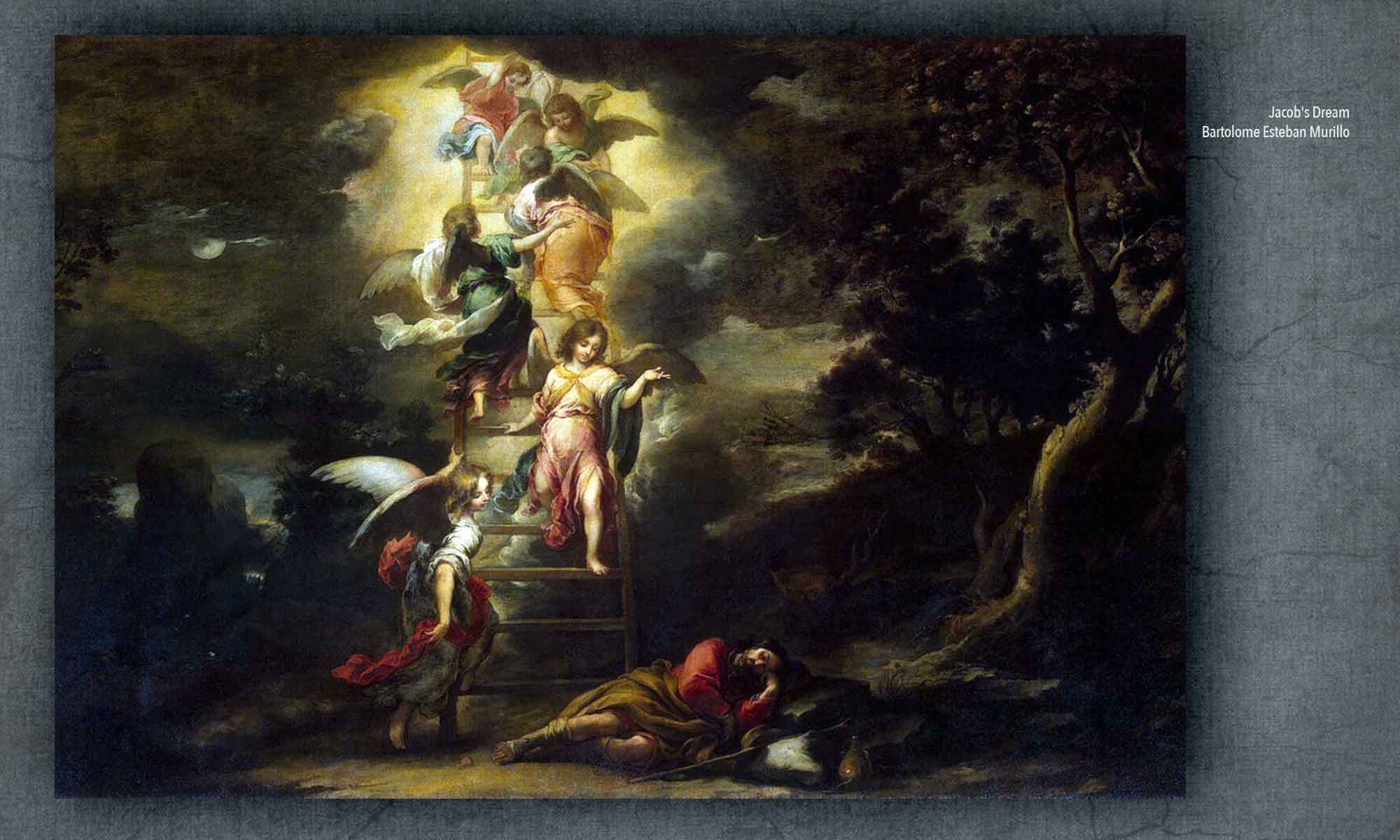
 The bizarre contents of dreaming can easily seem like the products of mental deficiency. “Children of an idle brain” is what Mercutio calls them in Romeo & Juliet (I.iv.102). Many scientists today essentially agree with Mercutio that the weird absurdities of dreams are evidence of diminished cognitive functioning during sleep.
But what if the “bizarreness” of dreaming is a sign of health and not disorder? What if, in some conditions at least, the increasing weirdness and unpredictability of dream content heralds genuine healing from serious psychological distress?
At the recent annual conference of the International Association for the Study of Dreams, Robert Hoss and Alwin Wagener analyzed a 45-year long series of PTSD nightmares from an American veteran of the Vietnam War. They found that over time, as the veteran healed from his psychological wounds, his nightmares included fewer direct or literal references to wartime violence and more references to other kinds of content, with a rising frequency of metaphorical and symbolic content. In other words, his nightmares gradually became dreamier. Instead of unrelenting graphic repetitions of the traumatizing event, he now experienced dreams involving new characters, settings, scenarios, and emotions.
This fits well with the findings of Harry Wilmer and others that long-term recovery from PTSD corresponds with changes in the frequency and contents of trauma-related nightmares. Wilmer observed that, “the emergence of an ordinary nightmare after prolonged recurrent reliving of the exact trauma in dreams is a healing process… It is the psyche’s attempt at healing.” (1996, 89)
It remains unclear which comes first, the shifts in dreaming or the psychological healing. But their close connection suggests an underlying process by which increasing dreaminess signals a loosening of the trauma’s grip and a return to the natural variability and freedom of dreaming experience.
This process also accords well with the theory that dreaming is a kind of play, the play of the imagination in sleep. Typical PTSD nightmares can be seen as the antithesis of play. Fixed in content and inescapable in their repetition, they are symptoms of an imagination paralyzed by the harsh reality of the trauma. But with time and the support of caring others a more playful spirit returns, bringing a renewed experiential awareness of creative freedom and the capacity to grow in the future.
A key implication for therapists is the value of monitoring changes in nightmare frequency and content as a potentially helpful window into the healing process. Those who already have active practices in play therapy or art therapy may find this insight especially congenial to their efforts, but any therapist who works with trauma can benefit from more attention to the vicissitudes and playful dynamics of dreaming.
Note: This post first appeared in Psychology Today on June 14, 2024.
 The neuroscience of dreams has shifted in recent years toward the idea that dreaming can be conceived as a kind of mind-wandering in sleep. According to current evidence, mind-wandering (also known as day-dreaming, or drifting thought) is a product of the “default mode network,” a system of neural regions that remains active in the absence of external stimulus or focused thought. During sleep this same system of neural regions becomes active, helping to generate the experience of dreaming.
 This is a post I recently wrote about the use of artificial intelligence (AI) systems in the practice of dream interpretation. In coordination with the team at the Elsewhere.to dream journaling app–Dan Kennedy, Gez Quinn, and Sheldon Juncker–we have been experimenting with “Freudian” and “Jungian” modes of interpretation, and the results are very encouraging. Maybe more than encouraging… I don’t highlight this in the post, but the AI interpretation in “Jungian” mode used the phrase “confrontation with the unconscious,” which was not part of the prompting text for the AI. In other words, the AI seems to have identified this phrase as a vital one in Jungian psychology (it’s the title of the pivotal chapter 6 of his memoir Memories, Dreams, Reflections) and, without any direct guidance, used it accurately and appropriately in an interpretation . I might even suspect a sly irony in using this phrase in reference to a dream of Freud’s, but that might be too much…
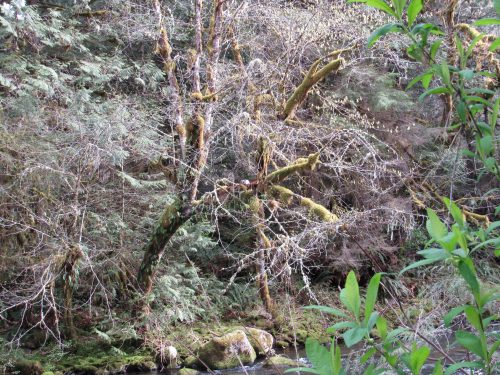 An outbreak of war and violent conflict is very likely to prompt a wave of nightmares of traumatic experiences, mournful losses, and threat simulations. This seems to be part of our internal crisis-response system when the external world descends into chaos and bloodshed, and our minds struggle to make sense of what is happening and find a way to survive the dangers.
 This has been a rough season for fans of the Portland Trailblazers basketball team. The players are learning a new system from their rookie head coach, Chauncey Billups, in his first season in that role. Their star player, Damien Lillard, plays poorly (by his standards) at the outset, then is forced to undergo season-ending surgery. Three other players in the original rotation—Cody Zeller, Larry Nance Jr., and Nassir Little—go down with injuries. The General Manager of the team, Neil Olshey, is summarily fired after years of internal conflict, leaving the operations in the hands of neophyte executives and detached ownership. Just before the trade deadline they deal away three of their best remaining players—Norman Powell, Robert Covington, Jr., and the beloved C.J. McCollum. In return the Blazers receive some promising guys (Josh Hart, Justice Winslow, Keon Johnson), plus draft picks and salary cap flexibility (an aspect of the game I don’t understand and don’t want to understand). In the midst of it all, the team wins a few surprising games, but loses many more, often by huge margins. Now, with a season-ending injury to Jusuf Nurkic, the lone remainder from the starting line-up at the beginning of the season, the Blazers have been reduced to a fragment of what they hoped to become this year.
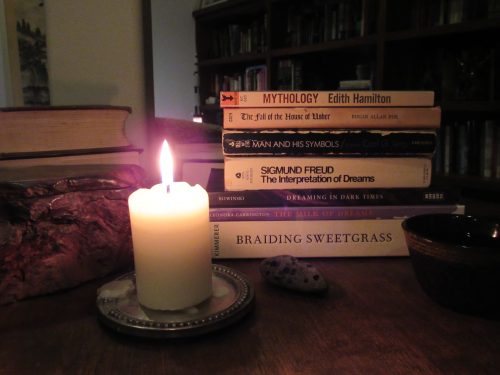 A Dream Library is a playground for studying and dreaming: for studying while dreaming, and dreaming while studying. It’s a spatial technology for stimulating your oneiric imagination. It’s not a shrine to dreaming, but it’s not not a shrine to dreaming, either. It’s your personally crafted portal into the intuitive depths of your own mind.