Why the Elsewhere Dream Journaling App Is the Best

As both a dreamer and a researcher, I find myself completely enchanted by the Elsewhere.to dream journaling app. Amazed. Smitten. Blown away. Impressed beyond all reckoning. And very excited about the future for dreamers all around the world. 

For the longest time, I wondered what it would take to create a dreamer’s playground: a private, safe, fun place to gather your dreams and freely explore them using a variety of high-quality tools and methods. It always seemed like an impossible fantasy… And now, Elsewhere has made that vision a reality by creating a garden of oneiric delights where you can play with your dreams, celebrate their multiplicities of meaning, and follow your curiosity wherever it leads. 

The Ethics of Online Dream Interpretation

Anything that has great potential for good also has great potential for harm. I would not be involved with Elsewhere were it not for its total commitment to an ethically minded approach, which I translate as simply doing your best to respect the dream and the dreamer. Treat the dream and the dreamer as ends, not means, as gifts to be honored rather than resources to be exploited. That’s the spirit that animates every aspect of the app’s design, from the back-end coding to the front-end user interface.

In practice, this underlies the policy that all information entered by Elsewhere users is privacy protected and will never be sold to a third-party. If for any reason you want your dreams back, you can have them, and all records of them will be removed from the app.

None of the tools or features within Elsewhere will tell you in a single, definitive way what your dreams mean. Instead, you are offered a variety of suggestions and possibilities from multiple perspectives.  Hopefully some of these interpretations will lead to helpful insights, but the ultimate authority is always held by you, the dreamer. Only the dreamer knows for sure what their dream means. 

New Features

Elsewhere is now available in more than 30 languages, which means these tools are potentially accessible to more than 99% of the human population. This bodes well for the future spread of dream awareness and education all around the world.

The primary function of the app, beyond recording and storing your dreams, is offering you a variety of tools to analyze their contents. These tools include ways to track the appearance of recurrent characters (e.g., parents, friends, celebrities), places (e.g., a beach, classroom, family home), and symbols (e.g., water, gun, mirror).

By recording your dreams on a regular basis, you build up an awareness of psychological rhythms that you may never have noticed within yourself before. You may also notice in reflecting on a long series of dreams that you can distinguish your unusual, highly memorable “big dreams” even more clearly, now that you have a better sense of the basic patterns underlying all your dreaming. 

Elsewhere users have become very creative in combining different features to enhance their dream journaling practice. In the past two years, the resources of artificial intelligence (AI) have been built into the app, providing what I now find are its two most stimulating features:

  • AI image generation: Elsewhere will create AI-generated images based on your dream and rendered in your chosen aesthetic style: Woodblock, Surreal Collage, Retro Camera, Storybook, Comic Book, Modern Illustration, Old Illustration, along with the option to write your own prompt. For me, this is the tool that yields the most surprising and intriguing results. The images are sometimes bizarrely different from my dreams, but even weird images can be thought-provoking if I look more closely at the image, not for what is missing but rather for what has been enhanced and highlighted beyond what I first noticed in the dream.
  • AI interpretations: Elsewhere also offers AI-generated interpretations of dreams in several different modes: Freudian, Jungian, Gestalt, Biblical, relational, spiritual, Lacanian, and the Elsewhere house mode, “Shadow.” These interpretations do not substitute for sharing dreams with other people, but they can provide multiple perspectives quickly and easily, giving the dreamer valuable input to consider while reflecting on their dream. Some of the interpretations are obvious, and others are completely off-base, but here, too, I am frequently surprised by the system offering ideas and viewpoints I have not considered and appreciate being brought to my awareness. 

Natural Therapy

The phrase “natural therapy” comes from Robert Kegan’s classic work of developmental psychology, The Evolving Self (1982). In the final chapter of this book, Kegan talks about the simple, non-specialized resources in ordinary life that support our psychological welfare, resources he believes have naturally therapeutic effects even if they are not administered by mental health professionals. He urges us to study these resources more closely:

“Rather than make the practice of psychotherapy the touchstone for all considerations of help, look first into the meaning and makeup of those instances of unselfconscious ‘therapy’ as these occur again and again in nature…[and seek] an understanding of ‘natural therapy’–those relations and human contexts which spontaneously support people through the sometimes difficult process of growth and change.” (256)

Although Kegan does not directly mention dreams in this chapter, I believe that dreaming and dream-sharing have these exact qualities and benefits. There is a tremendous amount of evidence from history and anthropology supporting the connection between dreams and healing. This connection is natural in the sense of being universally accessible and emerging without conscious intention, and yet it is also culturally amplified in responding creatively to the shared symbolic world of the dreamer’s waking reality. 

 Now, with the help of the powerful tools available in Elsewhere, more people can explore this resource in greater depth than ever before. This will hopefully be of special value to people who may not need formal psychotherapy but can still benefit from gaining more awareness and insight into their unconscious fears, conflicts, and desires. 

To be clear, if you need for help from a mental health professional, you should seek it out right away. As a matter of policy, Elsewhere explicitly says it does not claim to provide the services of a psychotherapist. However, in line with Kegan’s thinking, I suggest that Elsewhere does contribute to a form of “natural therapy” by supporting and enhancing people’s access to the beneficial powers of their own dreams. As these potentials begin to emerge into realities, it is worth remembering that dreaming has huge advantages for promoting the collective mental health of large communities insofar as it is free, accessible to everyone, and highly personalized in its relevance to the lived experiences of each individual. 

####

Here is an introductory post I wrote about Elsewhere two years ago:
The Elsewhere Dream Journaling App

2025 Dream Animation Film Festival 3

The winner of this year’s “Audience Choice” award went to Daniel Rabanea for “Bends.”

Daniel described the dream that inspired his film as follows:

“I was alone on the beach. At first everything seemed calm until the sea started to look strange. A wave formed and grew bigger and bigger. My fear grew along with the dark and chaotic wave, and I thought there was no escape. But when the big wave finally hit me, something unexpected happened, the wave didn’t hit me, on the contrary, it gently caressed my face. And everything slowly calmed down. There I remained, alone on the beach, perplexed, amazed, transformed.”

And this is the process Daniel used to transform his dream into an animated film:

“I had this dream around 2010 and wrote it down in my ideas pad. Fifteen years later, the Instagram algorithm introduced me to the Dream Animation Festival. After reading the submission rules I quickly remembered my old dream and decided to make this animation. Turning the dream into animation was an adventure full of discoveries. I believed it would be a more obvious adaptation, but I discovery that dream and animation have their own particularities, the dream strongly marked by subjective sensations and the animation by objective images and sounds. During the immersive production process I was able to reflect even more on the meanings of my dream. The external, the sea that bends into waves, the chaotic nature of the universe, in connection with the internal, subjectivity, the mind building itself in bends, the dreamy nature of consciousness. The succession of events, the transformation, the devir, “you cannot step into the same river twice”.

For anyone who has experienced a dream of being menaced by an enormous tidal wave, “Bends” offers a surprising alternative to the way these dreams usually end. Daniel’s use of simple graphite drawings provides lots of space for the viewer’s imagination to fill in the subjective experience of confronting a tidal wave. For such a short film (90 seconds) it builds to a strong emotional peak and then resolves in a moment of magical transformation. No wonder the audience loved it!

2025 Dream Animation Film Festival 2

The prize for this year’s Best Animation Style went to Daniele Grosso for “The Bird Insect Tornado.”

Here is Daniele’s description of the dream that inspired the film:

“I am at a picnic on the bank of a river with some friends. I notice a flock of pinkish colored bird insects flying around a tree. I start to film them, and the flock makes a beautiful movement in the air. Their movement suddenly becomes a tornado. We pick up our things and run towards some ruins where I think we can take refuge.”

The film uses sophisticated computer-generated imagery to bring us into a three-dimensional world populated by tiny bubbles endlessly morphing in and out of various shapes and forms. Linda Koncz, the festival administrator, said this of Daniele’s work:

“The entire visuality is built on bubbles, which makes me feel as though I’m underwater, in the subconscious, and the sounds of children laughing and wind add to the dreamlike atmosphere. Each frame built of bubbles is being blown away by the wind to create the next frame, just as in dreams, the connectedness of the parts is not linear, the story fragments connect in a free associative way, like a light wave of wind…(and then gets forgotten like a mandala blown away:)”

This year’s festival asked participants to consider dreams in relation to nature and the environment, and Daniele’s film achieves this by portraying the ever-changing dynamics of human interactions with other animate creatures and with the inanimate forces of nature. The bird-insects represent one kind of unusual merging and metamorphosis; the change of the bird-insects into a tornado represents an even more dramatic transformation. The trajectory of the dream suggests we humans may find these changes increasingly unfavorable to our peace and tranquility.

2025 Dream Animation Film Festival 1

The prize for this year’s “Best Animation Narrative” went to Jessie Rodriguez for “Dreams – A Memory of Ghosts.”


This is how Jessie describes her work, which all the judges of the festival agreed is an outstanding piece of dream creativity:

“My new animation, ‘Dreams: a Memory of Ghosts,’ explores how I seem to remember my dreams in fragments, little pieces that are still with me when I wake up. Seeing the theme of climate change, I focused on bringing to life the dreams I had around animals and the earth. I have chosen an animation style of an early silent film, with intertitles as a throw back to early cinema. In this animation I have it split into three Acts, each one came from a dream. The dreams I animated all came to life from February-March of this year when I was recording them.

  • Act 1-the Council: I look through the bushes and see a procession of animals who don’t know I am there, who seem to be having a secret meeting. They turn and look at me.
  • Act 2-Cat Boxes: A house has towers of covered plastic bins going up a hundred feet in the air. They start to fall down and cats emerge from all of them. I catch some bins unsure if I should let the cats out or keep the lid on.
  • Act 3-Premium Death Package: There is an old woman sitting by her future grave. She has purchased the premium death package that allows for up to $300,000 worth of classes each year she can take once she is dead. She eagerly awaits her descent into the grave.

To share with you a little about my process, I make all of my work and films completely by hand. I work out of Denver, Colorado in the United States. My stop motion animations are created from linocut printmaking. The techniques used to make these films involve creating every visual element from scratch. Characters, textures, background and text are made by hand carving each piece out of linoleum, hand printing onto paper and then cutting out, arranging and shooting frame by frame. I employ multi-plane and other experimental techniques for each animation. I love being able to bring my ideas to life through small-scale filmmaking, and am inspired by other filmmakers who used this process such as Lotte Reininger who worked entirely with shadows and cut paper.”

Speaking for myself (and not necessarily all the other festival judges), I was completely enchanted by the oneiric atmosphere Jessie creates in her work. The retro aesthetic—hand-crafted stop-motion in an old silent film format—generated for me a very dreamy and pleasantly uncanny feeling of open imagination and an awareness that the dynamism of the past is still a living presence today. The three-dream structure invites interpretive reflections on the symbolic and emotional interplay between the separate acts of the film. Each of the three dreams touches on the festival’s theme of nature and the environment, and each one expresses some special insight about the natural world, some little koan of ecological wisdom. Thank you, Jessie!

And thanks to Linda Koncz for administering the festival and the Elsewhere.to team–Gez Quinn, Kat Juncker, Dan Kennedy, and Victoria Philibert–for their support at all stages of the process.

Interpreting Dreams with AI-Generated Imagery

The image-generating power of new AI systems has huge untapped potential for the practice of dream interpretation—and some potential downsides. Even more than AI interpretive texts, the dramatic power of AI interpretive images may open new vistas for exploring the meanings of dreams.
The Value of Dream-Sharing

The difficulty most of us have in understanding our dreams is not because they are random nonsense but because dreams express our unconscious sense of open-ended possibility. Almost by definition, dreaming goes beyond the limits of our waking ego to consider new angles and alternate perspectives on our past experiences, current concerns, and future potentials. It is hard to understand dreams because they are continually reaching beyond where we are to explore what we might become.

This is why it can be so helpful to share dreams with other people, to benefit from the insights of their different points of view. Jeremy Taylor and Montague Ullman each developed methods for sharing dreams in virtually any social setting, whether you know the other group members or not. Their methods were designed to maximize the information gleaned from the group while minimizing the imposition of their views on the dreamer and preserving the dreamer’s sense of safety and control of the process.

New AI technology can now provide a kind of virtual dream-sharing group, offering interpretations of a dream from multiple angles. I know this best from using the Elsewhere.to dream journaling app, which has AI tools offering several interpretive modes. If you enter a dream and try each of these modes (Freudian, Jungian, Gestalt, etc.), you can experience an interesting virtual variant of a dream-sharing group, learning from the multiplicities of meanings generated by different modes.

AI Imagery

Already, AI can provide a decent simulation of a dream-sharing group in which the dreamer benefits from diverse comments and ideas. What AI can also now do, which would be very difficult to arrange with humans, is to provide in response to a dream with a variety of images in different styles. This offers an exciting new source of feedback for the dreamer, in a visual/imagistic rather than verbal/written form. For some dreams and some dreamers this may be an even more powerful interpretive method than a text-only approach.

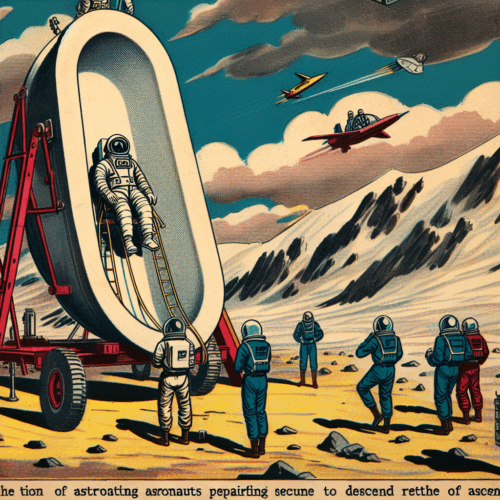
To test the idea, I tried it with one of my own dreams, one with a strong central image that would hopefully make it easier to compare and evaluate different visual renderings. Here is the dream, titled “Space Tub”:

Some people are in space, in a space station, and their job is getting astronauts ready for their missions. But wait, I realize something is different, not right—they are preparing the astronauts to go down, not up; and when I see the vehicle in which the astronauts are to travel, I am very disappointed. It is a large white plastic tub, big enough for one person to sit in. Not very complex at all, just thin hard plastic. I am confused, this is such a simplistic device, I can’t imagine it will actually work.

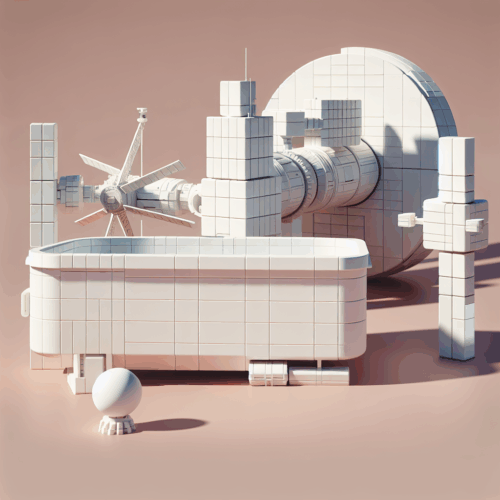
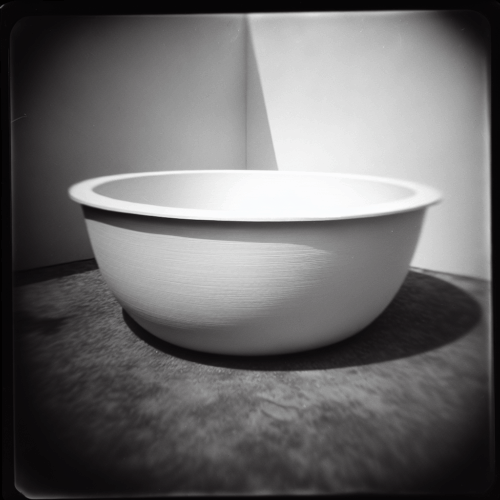
The first image, above, came from Elsewhere’s Retro Camera style.

It’s a white tub, for sure. No astronauts, no space station, although it is very simple and unlikely to do what’s needed for the astronauts. Looking at the image, I realize I don’t know what the astronauts actually need. Would they like this?

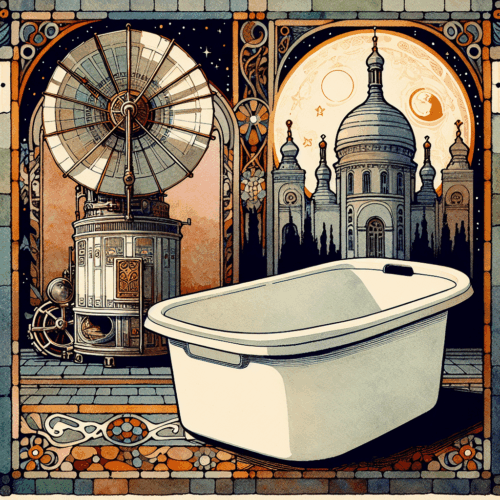
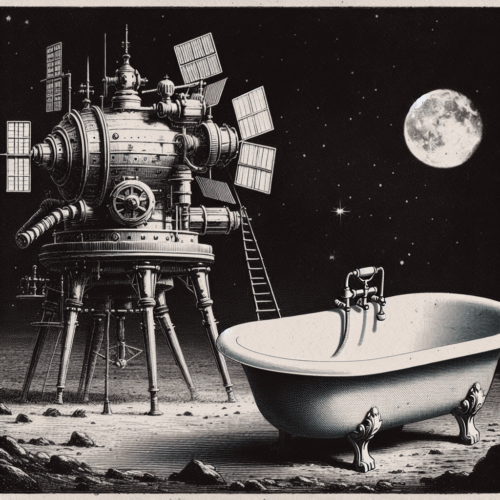
Next was the Old Illustration style:

There’s a basic anachronism in asking AI to use the style of one era to illustrate events from another era. Here, it’s a kind of steam-punk mechanism on a non-Earth planet somewhere in space. The white tub appears as a classic Victorian-era footed bathtub. This image foregrounds the themes of time and technology and makes me think of the tub in relation to water and bathing.

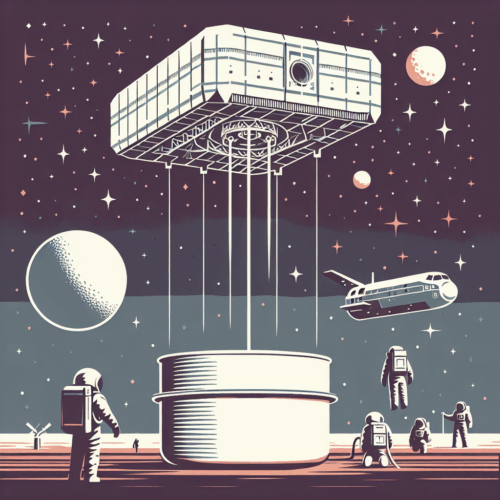
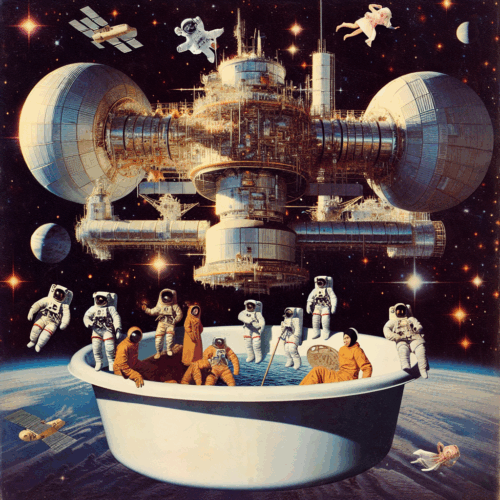
My favorite was the Surrealist Collage:

This one has a beautiful space station, a host of astronauts, and a cheap plastic bowl. It’s the only one of the three that picks up on the down/up anomaly. The tub has water in it, which isn’t the case in the dream, but the previous image also associated the tub with water, so that’s something new I can think about. It’s a very amusing image, like a party of astronauts in an orbital hot tub. That whimsical quality makes me think of the astronauts as liminal beings, or as liminal modes of being human, living in the space between heaven and earth.

None of these images is a perfect replica of my dream, but that’s okay. It’s much more stimulating to look at how the different images highlight some features and obscure others, bringing out details I might not have noticed so quickly on my own. As with any form of dream-sharing, the results can vary. Sometimes the image is completely off the mark, to the point where I get annoyed at the AI for being so obtuse. But sometimes the image is so rich and multi-faceted that I feel an immediate “aha!” of grateful insight and recognition.

Downsides

Most of the AI image-generating tools available today are enmeshed in the ethical quandaries surrounding this technology, including its smash-and-grab approach to intellectual property and its massive hunger for energy. How we resolve those issues is still an open question. Also concerning is the bias of AI systems toward the expected and familiar, for instance determining what’s the next most likely word. The creative freedom of dreaming means you never know what the next word is going to be. At some point, the basic determinism of AI may clash with the basic indeterminism of dreaming. Finally, it could be problematic if the AI-generated images were so vivid that they replaced people’s own internal memories of their dreams, like when you see a photo of a childhood event that shapes and perhaps even takes over your memory of the event. Whatever tools you use for dream interpretation, your own experience of the dream should always remain at the center.

[Note: this post first appeared on Psychology Today’s website on April 30, 2025. The additional text below only appears here.]

I tried each of the available Elsewhere styles with this dream, and here’s what the other ones look like:

Comic Book:

This one is pretty good–it gives a sense of how the tub is an improbable vehicle for astronauts to travel. There’s no space station, although the up-down dynamics are strong. I find the faux text distracting.

Modern Illustration:

Ouch. It’s white, there’s something like a space station, and something like a tub. But no astronauts, no space, no movement, no weirdness, none of the atmospherics of the dream.

Storybook:

Aesthetically pleasing, and there’s a white tub… And a few stars, if you look closely. Otherwise it has nothing to do with my dream. I do like the celestial feline in the top right.

Woodblock:

This one has a lot going for it. I didn’t expect the Woodcut style to do much with a space scene, but this one is very close to the perspective I felt in the dream, and it’s good on the use of the tub for astronauts traveling down. The space station is disappointingly simple, however, and I don’t like the two-tone coloring.

I’ll close by saying this is a really fun way of playing with a dream and exploring different possible meanings. With the downsides mentioned above still in mind, I look forward to trying this again soon.

SDDb Upgrade

At long last, after many twists and turns, a new and improved version of the Sleep and Dream Database (SDDb) has been released, just in time for spring! Many thanks to the Elsewhere.to team–Gez Quinn, Kat Juncker, Dan Kennedy, and Victoria Philibert–for their help in the upgrade process.  The SDDb is a growing archive of dream reports and survey data, with analytic tools designed to be used by anyone, from curious newcomers to advanced researchers. The SDDb offers two basic methods of studying dreams. One is to analyze the database’s collection of 18 demographic surveys to discover patterns of sleep and dreaming in relation to variables like age, ethnicity, sex assigned at birth, and religious beliefs. The second is to search the database’s collection of more than 45,000 dream reports gathered from many sources and available to study using built-in tools for identifying, analyzing, and comparing the frequencies of different categories of content.

Many features still need attention, along with better labeling for various questions and categories. Soon I will create written and video tutorials to help users navigate the SDDb’s collections and tools. With so much focus on the upgrade, I’ve been waiting to upload a few new series, and those should now get into the database in the very near future. If you have any suggestions to offer and/or problems to point out, I’d be grateful to hear them.