The Origins of Religion in Dreaming

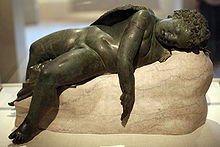
220px-WLA_metmuseum_Bronze_statue_of_Eros_sleeping_7One of the oldest theories about the origins of religion argues that religious beliefs and practices are derived from the experience of dreaming.  This theory is most often associated with the 19th century British anthropologist E.B. Tylor, as expressed in this passage from the 1873 work Primitive Culture:

“The evidence of visions corresponds with the evidence of dreams in their bearing on primitive theories of the soul, and the two classes of phenomena substantiate and supplement one another….That this soul should be looked on as surviving beyond death is a matter scarcely needing elaborate argument. Plain experience is there to teach it to every savage; his friend or his enemy is dead, yet still in dream or open vision he sees the spectral form which is to his philosophy a real objective being, carrying personality as it carries likeness.”

This same idea was also expressed, in even sharper language, by the German philosopher Friedrich Nietzsche just a few years later, in his 1880 book Human, All-Too Human:

“Misunderstanding of the dream. –The man of the ages of barbarous primordial culture believed that in the dream he was getting to know a second real world: here is the origin of all metaphysics.  Without the dream one would have had no occasion to divide the world into two. The dissection into soul and body is also connected with the oldest idea of the dream, likewise the postulation of a life of the soul, thus the origin of all belief in spirits, and probably also of the belief in gods.  ‘The dead live on, for they appear to the living in dreams’: that was the conclusion one formerly drew, throughout many millennia.”

I have just finished writing the manuscript for a book that tries to put this idea to the scientific test.  The book is titled Big Dreams: The Science of Dreaming and the Origins of Religion, and it will be published by Oxford University Press later this year or early next.  The basic thesis is that Tylor, Nietzsche, and others are right, dreaming is indeed an experiential source of religious beliefs and practices, and the best evidence from cognitive scientific research backs them up.

Rather than trying to give an all-encompassing theory of religion, I focus on a few specific areas of religious experience where dreams play an especially influential role: demonic seduction, prophetic vision, ritual healing, and contemplative practice.  The title of the book draws on psychologist C.G. Jung’s notion of “big dreams” as rare but extremely vivid dreams that make a strong and lasting impression on waking awareness.  I use resources from traditional psychology of religion (e.g., William James, Sigmund Freud) as well as from newer works in the cognitive science of religion (e.g., Emma Cohen, Harvey Whitehouse, James W. Jones) as guides in applying scientific dream research to the study of religion.

This is also the first book I’ve written using the Sleep and Dream Database (SDDb) as a primary resource.  I’m just learning how to use the digital tools of the database myself (an upgraded version of the site will come online in the next few days), and the more SDDb analyses I did for this book, the more excited I became about possibilities for future projects in data-driven dream research that look at religious and cultural phenomena with fresh, empirically curious eyes.

Tolkien’s Dreams, Past and Future

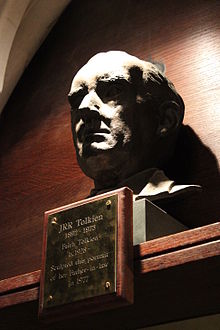
220px-Oxford_TolkienDreams play a significant role in The Lord of the Rings, J.R.R. Tolkien’s multi-part fantasy story written in the first half of the 20th century.  The dream elements become muted in Peter Jackson’s film adaptation, but in the novels they serve as an important source of insight for the characters.  According to Curt Hoffman in “Wings over Numenor: Lucid Dreaming in the Writing of J.R.R. Tolkien,” the dreams in the stories were modeled in many cases after Tolkien’s own dream experiences.  For instance, the Middle Earth legend of Numenor, a western land that was destroyed by a vast ocean wave, apparently derives from Tolkein’s personal “Atlantis Complex” and his recurrent dreams of huge, all-consuming waves.

Hoffman’s chapter appears in Lucid Dreaming: New Perspectives on Consciousness in Sleep, which Ryan Hurd and I edited for ABC-Clio.  Hoffman explains that the most remarkable story Tolkien ever wrote about dreams was also the only story he ever wrote set in the future, not in the past.  Titled “The Notion Club Papers,” Tolkien started it in 1946 but never finished the manuscript.  Hoffman says,

“The work purports to be the minutes of the fortnightly meetings of an Oxford literary society, the Notion Club (obviously a gloss for the Inklings [Tolkien’s actual literary club], although there is little one-for-one correspondence to its members), between 1980 and 1990. The manuscript’s conceit is that the papers “were found after the Summer Examinations of 2012, on the top of one of a number of sacks of waste paper in the basement of the Examinations Schools at Oxford by the present editor,” and it is represented to have been published in 2014.” (133)

Tolkien creates a strangely forward-telescoping, prospectively recursive way of framing the story—he writes about events that happen 40 years in the future, which are then discovered 20+ years after that, and are then published two years after that (at a time that happens to be our present).

In the story the club members engage in lengthy discussions of dreaming as a means of space and time travel, along with various accounts of strange adventures in thought and consciousness.  Without warning the discussion turns rather apocalyptic, as several club members describe visions that portend the coming of cataclysmic storms.  The manuscript breaks off there, and Tolkien never went back to it.  After careful study of this work, Hoffman concludes,

“It is entirely unclear what purpose Tolkien had in producing the Notion Club Papers, but his publishers were pressuring him at the time to get back to the writing of The Lord of the Rings, for obvious economic reasons, and this may explain why he did not finish the work. He never returned to it, and its status remains mysterious to this day. However, it is the clearest indication we have in all his writing of his interest in a variety of dream states and their relationship to waking physical reality. In particular, even though there is no evidence that he was aware of the writings of van Eeden on lucidity, it seems that Tolkien had a strong interest in lucid dreaming, based upon his own personal experience, and that he was attempting to put this into some kind of formulation in words that would make his experience more understandable, at least to his fellow Inklings.” (138)

Digital Dream Analysis: A New Article on Word Search Methods

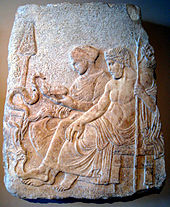
170px-Asclepius_and_hygieia_reliefThe latest issue of the journal Consciousness and Cognition has an article of mine titled “Digital dream analysis: A revised method,” that’s the fruition of several years of data-driven work.  It lays out the latest developments in testing and refining the word search template programmed into the Sleep and Dream Database, a digital archive and search engine designed to promote scientific dream research.  The original article I wrote using this word search method was in a 2009 issue of Consciousness and Cognition, titled “Seeking patterns in dream content: A systematic approach to word searches.”  The new article builds on that earlier piece and extends it in two ways.

First, it presents a revised, 2.0 version of the word search template that has many improvements on the 1.0 version presented in the 2009 article.  I’m sure there will be more refinements in the future, and hopefully more researchers developing their own templates as well.  But for now, the 2.0 version is useful as a well-tested and fairly comprehensive tool for analyzing dream content simply, quickly, and reliably.

Second, the article applies the 2.0 word search template to a number of previously studied collections of dreams from very high quality sources (Calvin Hall and Robert Van de Castle, J. Allan Hobson, and G. William Domhoff).  In doing so I followed the advice of Kurt Bollacker, database engineer for the SDDb, who suggested I take “classic” studies in dream research from the past and try applying my new method to their same data.  That’s what I have done in this article: use the word search method to analyze the same sets of dreams those researchers studied, so we can see what the new method can and cannot tell us about meaningful patterns in dream content.

Here is the abstract for the article.  The whole thing, I’m told, is available for free download until November 22, 2014.

“This article demonstrates the use of a digital word search method designed to provide greater accuracy, objectivity, and speed in the study of dreams.  A revised template of 40 word search categories, built into the website of the Sleep and Dream Database (SDDb), is applied to four “classic” sets of dreams: The male and female “Norm” dreams of Hall and Van de Castle (1966), the “Engine Man” dreams discussed by Hobson (1988), and the “Barb Sanders Baseline 250” dreams examined by Domhoff (2003).  A word search analysis of these original dream reports shows that a digital approach can accurately identify many of the same distinctive patterns of content found by previous investigators using much more laborious and time-consuming methods. The results of this study emphasize the compatibility of word search technologies with traditional approaches to dream content analysis.”

Robots Dreaming

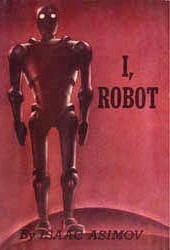
I_robot“I, Robot” (2004) is a movie about visions of the future that are haunted by dreams from the past.  Loosely based on Isaac Asimov’s classic sci-fi stories from the 1940’s, the film opens in 2035 with a harrowing nightmare that graphically repeats, PTSD-style, an accident suffered by homicide detective Del Spooner, played by Will Smith.  Several cars crashed and plunged into the Chicago River, and a robot dove into the water and rescued Spooner but not a little girl, whose chances of survival the robot deemed too low to justify trying to save.  After the agonizing experience of watching the girl sink down into the watery depths while he was lifted up to safety, Spooner becomes bitterly suspicious of all modern technologies and distrustful of claims that “intelligent” robots can improve human life.  Wearing his black leather trench coat and old-school Converse hi-tops like battle armor, Spooner is a man defiantly out of step with the march of cybernetic progress.

And then he gets a case that seems tailor made for his neo-Luddite paranoia: the first instance of a robot murdering a human.  Of course the case turns out to be much more than it first appears, and Spooner is gradually drawn into a deeper mystery about the nature of robots, humans, and the future of their relations.  At the center of the mystery is another dream—the dream of a robot.

The murder victim is Dr. Alfred Lanning (James Cromwell), a robot designer and a friend of Spooner’s.  The robot who apparently killed Dr. T. is named “Sonny” (Alan Tudyk), and Spooner finds that Sonny is far more personable than any other robot he’s ever seen, with emotions, existential questions, and a capacity to dream.

Spooner asks Sonny to describe his dreams, and the robot uses both hands to rapidly sketch an image of a large broken bridge, with a vast crowd below looking up at a single figure standing alone on a hill near the bridge.  Sonny says the single figure in the dream is going to liberate the crowd below from their oppression.  Dr. Susan Calvin (Bridget Moynahan), a colleague of Dr. Lanning who is also Spooner’s new love interest, suggests the lone figure might be Sonny himself.  Sonny considers that possibility, trusting humans to know more about the patterns of dreaming than he does.  But he also says he had the impression the liberating figure in the dream is Spooner.

Without giving away the whole plot, it can be noted that both interpretations of Sonny’s dream are true in some measure.  The climactic scenes of the movie take place near the broken bridge, so the dream has a prophetic, future-predicting quality to it.  The dream provides vital clues necessary to solve the mystery of Dr. Lanning’s death, it anticipates the character development of both Sonny and Spooner, and it heralds a revolutionary shift in robot-human interactions.  As with all “big dreams,” it has multiple levels of meaning and significance that play out across different timescales.

The ending of the film wraps up all the narrative threads, but it leaves the audience with an unsettling question.  If robots can really dream, what else might they envision about our collective future?  My guess is, it probably won’t be limited to fantasies of electric sheep.

The Technology of Dreaming

For myself I never found need of more than four or five hours’ sleep in the twenty-four. I never dream.”

So said the famously hard-working inventor Thomas Edison in 1921 in his Diary and Sundry Observations.  Edison claimed the only truly restful sleep was totally unconscious, and he regarded dreaming as a waste of mental energy that could be put to more productive use in waking life.

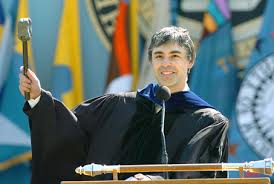
Nearly a century later Larry Page, another iconic figure of technological progress, offered a very different approach to dreams.  In a 2009 commencement address at the University of Michigan he said, “You know what it’s like to wake up in the middle of the night with a vivid dream? And you know how, if you don’t have a pencil and pad by the bed to write it down, it will be completely gone the next morning? Well, I had one of those dreams when I was 23.”  Page awoke from his dream and immediately began writing notes about downloading the entire worldwide web with all links intact—the seed idea for what he later built into Google.  His advice to the graduates: “When a really great dream shows up, grab it!

Which of these two world-changing innovators had it right? Should we strictly limit our sleep and ignore our dreams as Edison did?  Or should we listen to our dreams and try to follow them as Page recommended?
Thomas Edison nappingLight bulbLarry Page 2009

The world is filled with people trying to be like Edison, working nonstop and vowing to “sleep when I’m dead,” but this behavior appears foolish and self-defeating in light of current research in sleep medicine. Numerous studies over the past several decades have shown that inadequate sleep has a negative impact on human health, with harmful effects on our emotional, cognitive, physical, and immunological well-being.  What counts as “adequate” differs for each individual, but only a tiny portion of the population can sleep four or five hours a night and function the next day in an optimally healthy way.

The basic message of this research: A sure way to make yourself less productive is to artificially limit your individual sleep needs.

We can’t do without sleep.  But can we do without dreams?

The scientific evidence is less clear on this point.  Some people insist they never remember their dreams, although closer investigation usually finds they can recall a few dreams, just very infrequently.  (Even Edison mentioned a couple of dreams in his diary.)  Demographic surveys indicate most people remember one or two dreams a week.  Women tend to remember more dreams than men, and younger people more than older people.

Intriguingly, researchers have found that dream recall can be dramatically increased with little more than simple encouragement and having a pad of paper and pen by one’s bedside, as Page did.  It’s fairly easy, in other words, to remember more dreams if that’s what you want.  Build it and they will come.

Neuroscientists have begun to fill in the picture of what happens in the brain while we’re dreaming.  During rapid eye movement (REM) sleep, when most dreams seem to occur, activity slows down in the prefrontal cortex, the part of the brain most responsible for focused rational thought.  Activity increases in the limbic system, an older part of the brain involved with emotions, memory formation, and instinctual responses (e.g., fight/flight, sexual arousal).  Neural activity also increases in regions of the brain devoted to visual processing.

These findings make perfect sense in relation to empirical studies of dream content showing it to be loosely structured, highly associative, emotionally varied, and filled with intense visual images. The neuroscience of REM sleep matches up well with people’s subjective experiences of dreams, giving us more confidence there’s a real connection here between brain and mind.

Dreaming now seems best understood as the psychological expression of a distinctive mode of brain functioning devoted to memory, emotion, and playful meaning-making. It is inherently and powerfully creative, not only in producing experiential worlds of astonishing depth and realism but also in stretching our minds to make surprising new connections between disparate ideas, feelings, and impressions.  Contrary to the stereotype of dreams as nothing but random nonsense, current research shows their content is meaningful at many levels, accurately reflecting our most important concerns and activities in waking life.

Edison was right to this extent: We can ignore our dreams, if we so choose.  But Page was right on the bigger point.  Dreaming is not wasteful; it has its own neurological integrity and psychological value.  It taps into a deep inner wellspring of creative thinking that leads us beyond what is to imagine what might be.

In this sense we can think of dreaming as a kind of innate technology of the mind, a natural tool of creative consciousness.

The question for dream researchers then becomes, how can we use that tool better?  How can we refine it, improve it, make it stronger?

This might sound like the start of a Dr. Frankenstein tale, with mad scientists rashly meddling in mysteries they don’t understand.  But we are not the first to ask these questions.  Throughout history, in cultures all over the world, people have used a variety of techniques to actively stimulate their inborn capacity for powerful dreaming.

For example, the Native American ritual of the vision quest involves several days and nights of solitary fasting in the wilderness as a means of inviting a revelatory dream.  The Muslim practice of istikhara uses special prayers, purifications, and sleep positions to elicit a dream that helps resolve an important question or decision.  The Indian sage Naropa taught his followers how to control their dreams through yogic methods of chanting, breathing, visualizations, and bodily postures.  Temples devoted to the Greek god Asclepius thrived for centuries as holy sites where people came to worship, diet, exercise, and sleep in hopes of receiving a healing dream.

Cultural practices like these represent time-honored, ethically sensitive techniques for intensifying dreams and deriving more insight from them.     

Eventually we will integrate our best models of dream content with highly advanced neuroscientific maps of brain activity during sleep, and this will set the stage for a new generation of technologies that directly stimulate the brain to produce more creative dream experiences.  By fine-tuning the neural parameters of sleep we’ll be able to filter out the noise and amplify the signals of the dreaming imagination.
George Lucas

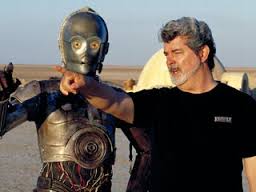
Undoubtedly this will be good news for the movie business.  As George Lucas recently said at the USC School of Cinematic Arts when asked to predict the future of film, “The next step is to be able to control your dreams. You’ll just tap into a different part of your brain. You’re just going to put a hat on or plug into the computer and create your own world… We’ll be able to do the dream thing 10, 15 years from now. It’s not some pie-in-the-sky thing.”

That timeline seems about right to me, although I would envision devices that generate a more interactive and mutually respectful process between waking and dreaming, with a focus on awareness and growth rather than control for control’s sake.

Beyond their entertainment value, these dream technologies of the not-so-distant future will help us cultivate a more unified consciousness that takes advantage of our brain’s amazing creativity throughout all phases of the sleep-wake cycle.

####

Note: This essay also appears on the Huffington Post: http://www.huffingtonpost.com/kelly-bulkeley-phd/the-technology-of-dreaming_b_4378041.html


Thanks to Larry Lessig, Kurt Bollacker, and Jaron Lanier

In developing the Sleep and Dream Database (SDDb), a digital archive and search engine for dream research, I have been acutely aware that I possess no formal training in computer science or internet technology.  My doctoral degree is in religion and psychological studies, and I learned many things in the course of my graduate education, but nothing about how to conceive, build, or use a digital database.


Fortunately I’ve benefitted from the wisdom of three people—Larry Lessig, Kurt Bollacker, and Jaron Lanier—who have helped me understand how to translate my psychology of religion interest in dreams into the functional mechanics of a digital database.

UnknownLarry Lessig was a first-year law school student with my soon-to-be wife at the University of Chicago, at the same time I was a doctoral student at the U. of Chicago Divinity School.  It was 1986 and 1987, and we spent a lot of time hanging out with Larry and a few other frighteningly smart, frighteningly conservative law students.  Once I asked Larry what he was doing for fun, and he said he was spending a lot of time in cyberspace.  I had recently read William Gibson’s 1984 novel Neuromancer, which popularized the term cyberspace, and excitedly I said to Larry, I’ve been reading Gibson’s work too, it’s so interesting how he envisions a disembodied reality of pure information flows…. Larry let me finish, then said he was spending time in actual cyberspace, exploring the earliest iterations of the world wide web.  While I was reading cool science fiction about cyberspace, Larry was really in cyberspace, figuring it out, studying its original development as it happened.

I look back on that conversation and think of it as planting a seed that’s coming to fruition now with the SDDb.  In 1999 Larry wrote a book called Code, and Other Laws of Cyberspace, and from that book I’ve learned the basic principle that everything we create in the digital world depends on the choices we make about how to structure information and its access.  It’s not just machines doing things on their own, it’s us making machines that do certain things and not others.  We can make good choices or bad choices about how we design those machines, freedom-affirming choices or freedom-limiting choices.

Thanks, Larry, for helping me understand that.

Unknown-1I met Kurt Bollacker through Dominic Luscinci, a statistician in San Francisco who had worked with Kurt on another database design project.  I really can’t believe my good fortune in having Kurt help me turn the SDDb from several pages of scribbled notes into a highly functional reality.  I’ve learned a little about his work as Digital Research Director of the Long Now Foundation, and it reassures me that I have found a person who has not only the technical skill to build the SDDb but also the philosophical vision to see where the digital future is leading us, and to design the database with that vision in mind.

One of the things I learned from Kurt early on was, “Data accumulate value over time.”  I’ve adopted that as a kind of mantra for the SDDb.  Data accumulate value over time.  Information that seems trivial or useless today can be a treasure to researchers in the future.  An awareness of that historical dynamic has a practical consequence for building databases: It means we should aim at a simple, flat, and state-free architecture that can exist independently of any specific type of software.  Because software systems come and go, the best way to create a database that will endure far into the future is to structure the information in a way that will make it easy to transfer from one type of software to another. That’s a key principle in the overall design of the SDDb, and one that I hope will make the database useful to dreamers and researchers for many years to come.

For that and more, thanks, Kurt.

Unknown-2The third person I want to acknowledge as an influence is Jaron Lanier and his book You Are Not a Gadget. I’m a religious studies scholar, so forgive me, but Jaron strikes me as a latter-day techno-prophet, warning us of the apocalyptic perils that lie ahead if we allow soulless machines to become our masters.  His book is a passionate call to fight against “cybernetic totalism” and the economic power of “lord aggregators” of the web—I love that term—whose driving interest is to commercially exploit our personal information.  As someone trying to build a database that includes a lot of personal information, I have thought long and hard about Jaron’s cautionary ideas, and I’ve done my best to design the SDDb in a way that will enhance rather than diminish people’s freedom and creativity in exploring the world of dreams.

I read Jaron’s book in the summer of 2011, and soon afterwards he was profiled in a New Yorker magazine article.  The article was actually kind of lame, focusing more on his counter-cultural appearance and behavior than the substance of his ideas.  Well, as fate or synchronicity would have it, the day after the New Yorker article came out, I bumped into Jaron down at the market, Andronico’s at the corner of Shattuck and Cedar in north Berkeley.  He was there with his daughter in the produce section.  Normally I’m very reluctant to just walk up and talk to anyone, let alone prominent people, but this was too coincidental, especially since I had learned in Jaron’s book about a 15th century text called “Poliphili’s Strife of Love in a Dream,” a fantastic dream text I’d never heard of before, which I immediately bought and started reading.

So anyway, we were both picking through the lemons, and I went ahead and said hi, I just read that New Yorker article about you. Jaron said yeah, he didn’t really recognize the person they were describing in the article. I quickly tried to think of something to say about how much I valued his ideas, but I’m not a very quick thinker, so all I could come up with was to say thanks for teaching me about “Poliphili’s Strife of Love in a Dream.”  I’m sure that comment came across as completely weird and off the wall, and so I hastily moved on to the cereal aisle, and that was that.

So Jaron, if you ever see this, I’m really sorry for stalking you in the Andronico’s produce section a couple of years ago.  What I really want to do is thank you, along with Larry and Kurt, for inspiring the mission, the content, and the code of the Sleep and Dream Database.  Thanks to you all.