Why the Elsewhere Dream Journaling App Is the Best

As both a dreamer and a researcher, I find myself completely enchanted by the Elsewhere.to dream journaling app. Amazed. Smitten. Blown away. Impressed beyond all reckoning. And very excited about the future for dreamers all around the world. 

For the longest time, I wondered what it would take to create a dreamer’s playground: a private, safe, fun place to gather your dreams and freely explore them using a variety of high-quality tools and methods. It always seemed like an impossible fantasy… And now, Elsewhere has made that vision a reality by creating a garden of oneiric delights where you can play with your dreams, celebrate their multiplicities of meaning, and follow your curiosity wherever it leads. 

The Ethics of Online Dream Interpretation

Anything that has great potential for good also has great potential for harm. I would not be involved with Elsewhere were it not for its total commitment to an ethically minded approach, which I translate as simply doing your best to respect the dream and the dreamer. Treat the dream and the dreamer as ends, not means, as gifts to be honored rather than resources to be exploited. That’s the spirit that animates every aspect of the app’s design, from the back-end coding to the front-end user interface.

In practice, this underlies the policy that all information entered by Elsewhere users is privacy protected and will never be sold to a third-party. If for any reason you want your dreams back, you can have them, and all records of them will be removed from the app.

None of the tools or features within Elsewhere will tell you in a single, definitive way what your dreams mean. Instead, you are offered a variety of suggestions and possibilities from multiple perspectives.  Hopefully some of these interpretations will lead to helpful insights, but the ultimate authority is always held by you, the dreamer. Only the dreamer knows for sure what their dream means. 

New Features

Elsewhere is now available in more than 30 languages, which means these tools are potentially accessible to more than 99% of the human population. This bodes well for the future spread of dream awareness and education all around the world.

The primary function of the app, beyond recording and storing your dreams, is offering you a variety of tools to analyze their contents. These tools include ways to track the appearance of recurrent characters (e.g., parents, friends, celebrities), places (e.g., a beach, classroom, family home), and symbols (e.g., water, gun, mirror).

By recording your dreams on a regular basis, you build up an awareness of psychological rhythms that you may never have noticed within yourself before. You may also notice in reflecting on a long series of dreams that you can distinguish your unusual, highly memorable “big dreams” even more clearly, now that you have a better sense of the basic patterns underlying all your dreaming. 

Elsewhere users have become very creative in combining different features to enhance their dream journaling practice. In the past two years, the resources of artificial intelligence (AI) have been built into the app, providing what I now find are its two most stimulating features:

  • AI image generation: Elsewhere will create AI-generated images based on your dream and rendered in your chosen aesthetic style: Woodblock, Surreal Collage, Retro Camera, Storybook, Comic Book, Modern Illustration, Old Illustration, along with the option to write your own prompt. For me, this is the tool that yields the most surprising and intriguing results. The images are sometimes bizarrely different from my dreams, but even weird images can be thought-provoking if I look more closely at the image, not for what is missing but rather for what has been enhanced and highlighted beyond what I first noticed in the dream.
  • AI interpretations: Elsewhere also offers AI-generated interpretations of dreams in several different modes: Freudian, Jungian, Gestalt, Biblical, relational, spiritual, Lacanian, and the Elsewhere house mode, “Shadow.” These interpretations do not substitute for sharing dreams with other people, but they can provide multiple perspectives quickly and easily, giving the dreamer valuable input to consider while reflecting on their dream. Some of the interpretations are obvious, and others are completely off-base, but here, too, I am frequently surprised by the system offering ideas and viewpoints I have not considered and appreciate being brought to my awareness. 

Natural Therapy

The phrase “natural therapy” comes from Robert Kegan’s classic work of developmental psychology, The Evolving Self (1982). In the final chapter of this book, Kegan talks about the simple, non-specialized resources in ordinary life that support our psychological welfare, resources he believes have naturally therapeutic effects even if they are not administered by mental health professionals. He urges us to study these resources more closely:

“Rather than make the practice of psychotherapy the touchstone for all considerations of help, look first into the meaning and makeup of those instances of unselfconscious ‘therapy’ as these occur again and again in nature…[and seek] an understanding of ‘natural therapy’–those relations and human contexts which spontaneously support people through the sometimes difficult process of growth and change.” (256)

Although Kegan does not directly mention dreams in this chapter, I believe that dreaming and dream-sharing have these exact qualities and benefits. There is a tremendous amount of evidence from history and anthropology supporting the connection between dreams and healing. This connection is natural in the sense of being universally accessible and emerging without conscious intention, and yet it is also culturally amplified in responding creatively to the shared symbolic world of the dreamer’s waking reality. 

 Now, with the help of the powerful tools available in Elsewhere, more people can explore this resource in greater depth than ever before. This will hopefully be of special value to people who may not need formal psychotherapy but can still benefit from gaining more awareness and insight into their unconscious fears, conflicts, and desires. 

To be clear, if you need for help from a mental health professional, you should seek it out right away. As a matter of policy, Elsewhere explicitly says it does not claim to provide the services of a psychotherapist. However, in line with Kegan’s thinking, I suggest that Elsewhere does contribute to a form of “natural therapy” by supporting and enhancing people’s access to the beneficial powers of their own dreams. As these potentials begin to emerge into realities, it is worth remembering that dreaming has huge advantages for promoting the collective mental health of large communities insofar as it is free, accessible to everyone, and highly personalized in its relevance to the lived experiences of each individual. 

####

Here is an introductory post I wrote about Elsewhere two years ago:
The Elsewhere Dream Journaling App

Interpreting Dreams with AI-Generated Imagery

The image-generating power of new AI systems has huge untapped potential for the practice of dream interpretation—and some potential downsides. Even more than AI interpretive texts, the dramatic power of AI interpretive images may open new vistas for exploring the meanings of dreams.
The Value of Dream-Sharing

The difficulty most of us have in understanding our dreams is not because they are random nonsense but because dreams express our unconscious sense of open-ended possibility. Almost by definition, dreaming goes beyond the limits of our waking ego to consider new angles and alternate perspectives on our past experiences, current concerns, and future potentials. It is hard to understand dreams because they are continually reaching beyond where we are to explore what we might become.

This is why it can be so helpful to share dreams with other people, to benefit from the insights of their different points of view. Jeremy Taylor and Montague Ullman each developed methods for sharing dreams in virtually any social setting, whether you know the other group members or not. Their methods were designed to maximize the information gleaned from the group while minimizing the imposition of their views on the dreamer and preserving the dreamer’s sense of safety and control of the process.

New AI technology can now provide a kind of virtual dream-sharing group, offering interpretations of a dream from multiple angles. I know this best from using the Elsewhere.to dream journaling app, which has AI tools offering several interpretive modes. If you enter a dream and try each of these modes (Freudian, Jungian, Gestalt, etc.), you can experience an interesting virtual variant of a dream-sharing group, learning from the multiplicities of meanings generated by different modes.

AI Imagery

Already, AI can provide a decent simulation of a dream-sharing group in which the dreamer benefits from diverse comments and ideas. What AI can also now do, which would be very difficult to arrange with humans, is to provide in response to a dream with a variety of images in different styles. This offers an exciting new source of feedback for the dreamer, in a visual/imagistic rather than verbal/written form. For some dreams and some dreamers this may be an even more powerful interpretive method than a text-only approach.

To test the idea, I tried it with one of my own dreams, one with a strong central image that would hopefully make it easier to compare and evaluate different visual renderings. Here is the dream, titled “Space Tub”:

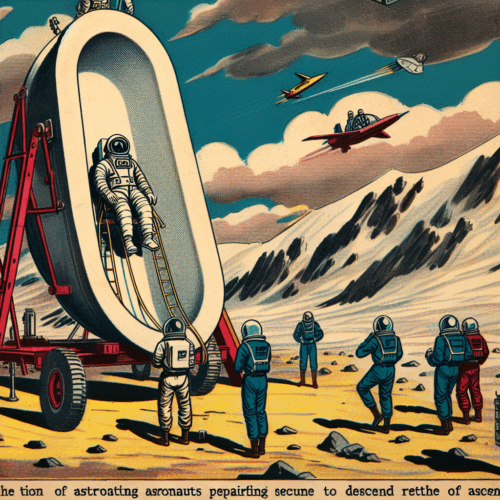
Some people are in space, in a space station, and their job is getting astronauts ready for their missions. But wait, I realize something is different, not right—they are preparing the astronauts to go down, not up; and when I see the vehicle in which the astronauts are to travel, I am very disappointed. It is a large white plastic tub, big enough for one person to sit in. Not very complex at all, just thin hard plastic. I am confused, this is such a simplistic device, I can’t imagine it will actually work.

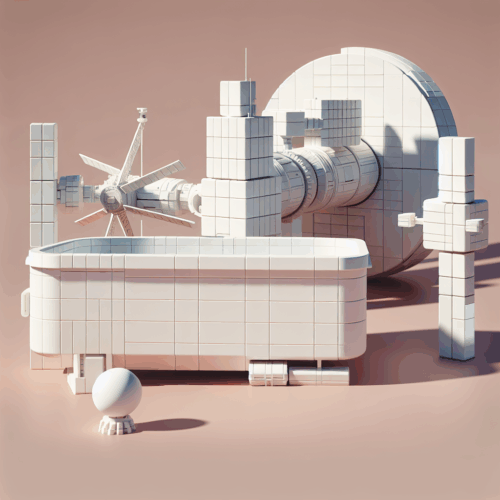
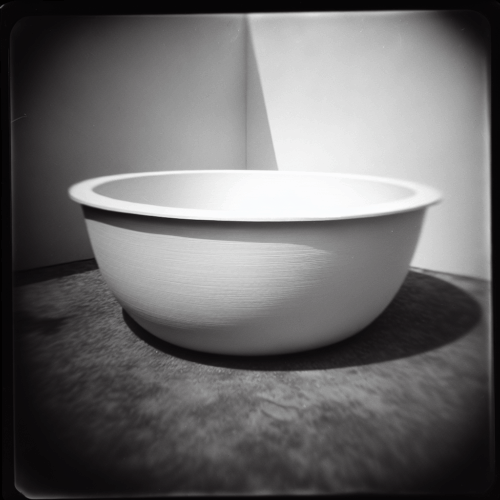
The first image, above, came from Elsewhere’s Retro Camera style.

It’s a white tub, for sure. No astronauts, no space station, although it is very simple and unlikely to do what’s needed for the astronauts. Looking at the image, I realize I don’t know what the astronauts actually need. Would they like this?

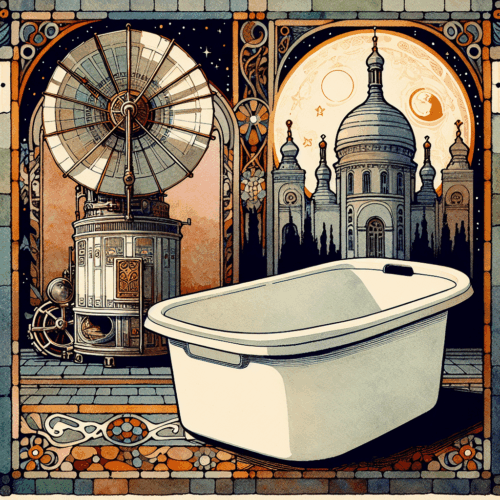
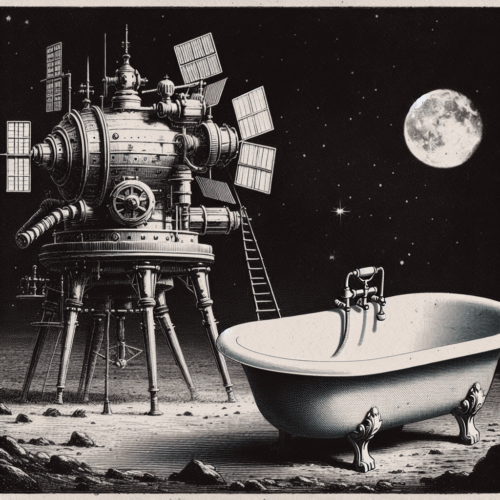
Next was the Old Illustration style:

There’s a basic anachronism in asking AI to use the style of one era to illustrate events from another era. Here, it’s a kind of steam-punk mechanism on a non-Earth planet somewhere in space. The white tub appears as a classic Victorian-era footed bathtub. This image foregrounds the themes of time and technology and makes me think of the tub in relation to water and bathing.

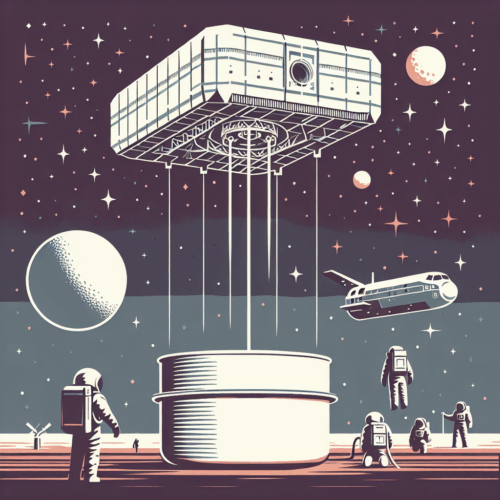
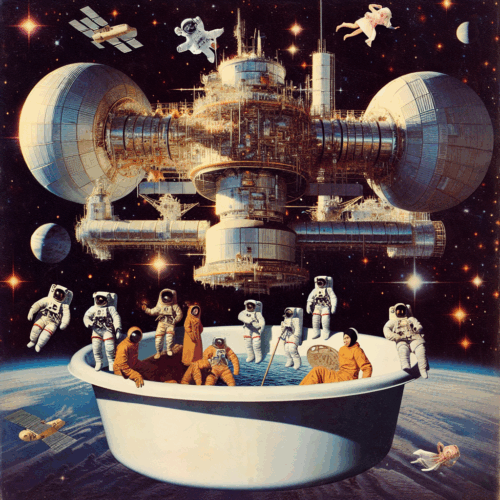
My favorite was the Surrealist Collage:

This one has a beautiful space station, a host of astronauts, and a cheap plastic bowl. It’s the only one of the three that picks up on the down/up anomaly. The tub has water in it, which isn’t the case in the dream, but the previous image also associated the tub with water, so that’s something new I can think about. It’s a very amusing image, like a party of astronauts in an orbital hot tub. That whimsical quality makes me think of the astronauts as liminal beings, or as liminal modes of being human, living in the space between heaven and earth.

None of these images is a perfect replica of my dream, but that’s okay. It’s much more stimulating to look at how the different images highlight some features and obscure others, bringing out details I might not have noticed so quickly on my own. As with any form of dream-sharing, the results can vary. Sometimes the image is completely off the mark, to the point where I get annoyed at the AI for being so obtuse. But sometimes the image is so rich and multi-faceted that I feel an immediate “aha!” of grateful insight and recognition.

Downsides

Most of the AI image-generating tools available today are enmeshed in the ethical quandaries surrounding this technology, including its smash-and-grab approach to intellectual property and its massive hunger for energy. How we resolve those issues is still an open question. Also concerning is the bias of AI systems toward the expected and familiar, for instance determining what’s the next most likely word. The creative freedom of dreaming means you never know what the next word is going to be. At some point, the basic determinism of AI may clash with the basic indeterminism of dreaming. Finally, it could be problematic if the AI-generated images were so vivid that they replaced people’s own internal memories of their dreams, like when you see a photo of a childhood event that shapes and perhaps even takes over your memory of the event. Whatever tools you use for dream interpretation, your own experience of the dream should always remain at the center.

[Note: this post first appeared on Psychology Today’s website on April 30, 2025. The additional text below only appears here.]

I tried each of the available Elsewhere styles with this dream, and here’s what the other ones look like:

Comic Book:

This one is pretty good–it gives a sense of how the tub is an improbable vehicle for astronauts to travel. There’s no space station, although the up-down dynamics are strong. I find the faux text distracting.

Modern Illustration:

Ouch. It’s white, there’s something like a space station, and something like a tub. But no astronauts, no space, no movement, no weirdness, none of the atmospherics of the dream.

Storybook:

Aesthetically pleasing, and there’s a white tub… And a few stars, if you look closely. Otherwise it has nothing to do with my dream. I do like the celestial feline in the top right.

Woodblock:

This one has a lot going for it. I didn’t expect the Woodcut style to do much with a space scene, but this one is very close to the perspective I felt in the dream, and it’s good on the use of the tub for astronauts traveling down. The space station is disappointingly simple, however, and I don’t like the two-tone coloring.

I’ll close by saying this is a really fun way of playing with a dream and exploring different possible meanings. With the downsides mentioned above still in mind, I look forward to trying this again soon.

Freud, Jung, and AI-generated Dream Interpretation

This is a post I recently wrote about the use of artificial intelligence (AI) systems in the practice of dream interpretation.  In coordination with the team at the Elsewhere.to dream journaling app–Dan Kennedy, Gez Quinn, and Sheldon Juncker–we have been experimenting with “Freudian” and “Jungian” modes of interpretation, and the results are very encouraging. Maybe more than encouraging… I don’t highlight this in the post, but the AI interpretation in “Jungian” mode used the phrase “confrontation with the unconscious,” which was not part of the prompting text for the AI. In other words, the AI seems to have identified this phrase as a vital one in Jungian psychology (it’s the title of the pivotal chapter 6 of his memoir Memories, Dreams, Reflections) and, without any direct guidance, used it accurately and appropriately in an interpretation . I might even suspect a sly irony in using this phrase in reference to a dream of Freud’s, but that might be too much…


Freud and Jung Sharing Their Dreams: An AI Revival

New technologies are transforming the practice of dream interpretation.

In 1909, on their way by steam ship to give lectures at Clark University in the United States, Sigmund Freud and Carl Jung passed the time by sharing and interpreting each other’s dreams. This was a truly a peak moment in the history of dreaming—yet a fleeting moment, too. Soon afterward, their disagreements about psychoanalytic theory worsened, and they finally broke off all relations with each other.

Ever since, we have been left to wonder… What if these two giants of twentieth-century psychology had continued sharing their dreams? What if, instead of becoming estranged rivals, they had collaborated in developing a meta-method that deployed each of their interpretation systems in a flexible yet integrated practice?

An answer to these questions is suddenly coming into focus, thanks to emerging uses of artificial intelligence (AI) in the study of dreams. It is now possible for a carefully trained AI system to generate distinctly Freudian and Jungian interpretations of a dream. We can thus revive the spirit of their epic 1909 dream-sharing journey by offering one of their (already-published) dreams for interpretation by the other and reflecting on the interplay of their dual perspectives.

Freud would likely be curious about the dream Jung reports in chapter 5 of Memories, Dreams, Reflections, which occurred just before their falling out. Set in a bustling Italian city, the dream centers on the anomalous presence of a medieval knight. Jung is shocked at the sight–“suddenly to see in a modern city, during the noonday rush hour, a crusader coming toward me”—especially because Jung realizes only he can see the knight, who is invisible to everyone else. Jung said the dream anticipated his turn away from Freud and towards a more meaningful search for higher truths, comparable to the Grail Quest.

How might Freud interpret this dream? Using an AI system crafted with the developers at the Elsewhere dream journaling app, where I am an unpaid research advisor, we can apply a “Freudian mode” of interpretation to Jung’s dream. I will quote the first and last few sentences of the AI response:

“The dreamer’s description of a knight in full armor walking through an Italian city suggests a possible egocentric wish. The knight, a figure associated with power, honor, and bravery, might symbolize the dreamer’s desire for recognition and admiration. The fact that the knight is visible only to the dreamer could indicate a feeling of uniqueness or a wish to stand out from the crowd… This dream seems to primarily reflect the dreamer’s egocentric wishes and possibly repressed sexual and aggressive desires. The dreamer might be yearning for recognition and admiration, while also grappling with fears of being overlooked or ignored. The knight in armor could symbolize these conflicting desires and fears.”

This may not be the most profound reading of the dream, but it is easily recognizable as a Freudian approach, with clear connections to psychoanalytic theory. It also happens to be consistent with biographical information about Freud’s view of Jung after the split—as a grandiose savior bent on turning psychology into religion.

Jung, in turn, might want to explore a vivid childhood nightmare that Freud mentions off-handedly near the end of The Interpretation of Dreams. It’s a short dream of his mother, “with a peculiarly peaceful, sleeping expression on her features, being carried into the room by two (or three) people with birds’ beaks and laid upon the bed. I awoke in tears and screaming.”  The bird figures referred to strange illustrations from an old family Bible. Freud offers the dream as a self-evident example of an anxiety dream rooted in a sexual wish (i.e., an Oedipal desire for the mother).

How might Jung have interpreted this dream? Using the same AI system in its “Jungian mode,” the interpretation begins like this:

“The dream presents a potent mix of archetypal and personal symbols that indicate a deep process of transformation and individuation occurring within the dreamer’s psyche. The image of the mother, a universal symbol of nurturing, care, and life itself, is presented in a peaceful, sleeping state. This suggests that some aspect of the dreamer’s relationship with the nurturing, caring part of their psyche is in a dormant or inactive state.”

The interpretation goes on to highlight the religious symbolism of birds:

“Birds are often symbols of spiritual messengers or intermediaries between the earthly and the divine. In the Bible, they can represent both divine providence and impending doom.”

And it offers surprisingly sensitive words of encouragement to endure the inevitable struggles of psychological growth:

“The dreamer’s intense emotional reaction upon awakening – tears and screaming – indicates that this transformation is not easy or painless. It’s a significant upheaval, a profound shift in the dreamer’s self-concept and understanding of their place in the world. But this upheaval, this confrontation with the unconscious, is a necessary part of the individuation process. It’s through such confrontations that we come to know ourselves more fully, to integrate the disparate aspects of our psyche into a more cohesive, more authentic whole.”

This AI-generated interpretation can be readily identified as a Jungian approach and a plausible application of his theory to Freud’s dream. Moreover, it accords with what we know of Jung’s post-split view of Freud—that he never found a way to integrate the aggressive authority of the father with the intuitive wisdom of the mother.

The significance here is not just revealing alternate perspectives on these two dreams and their famous dreamers. This little experiment with Freud and Jung is like a horseless carriage, using a new technology to solve old problems. What will happen when these tools are applied to new problems, when they are used by a wide range of people to explore currently unknown opportunities? What new models of the mind and practices of healing will emerge? What new theories of art, culture, religion, and social change will appear on the horizon?

Maybe it’s time to start developing a “Prophetic mode”…


Note: Originally posted in Psychology Today, February 8, 2024.