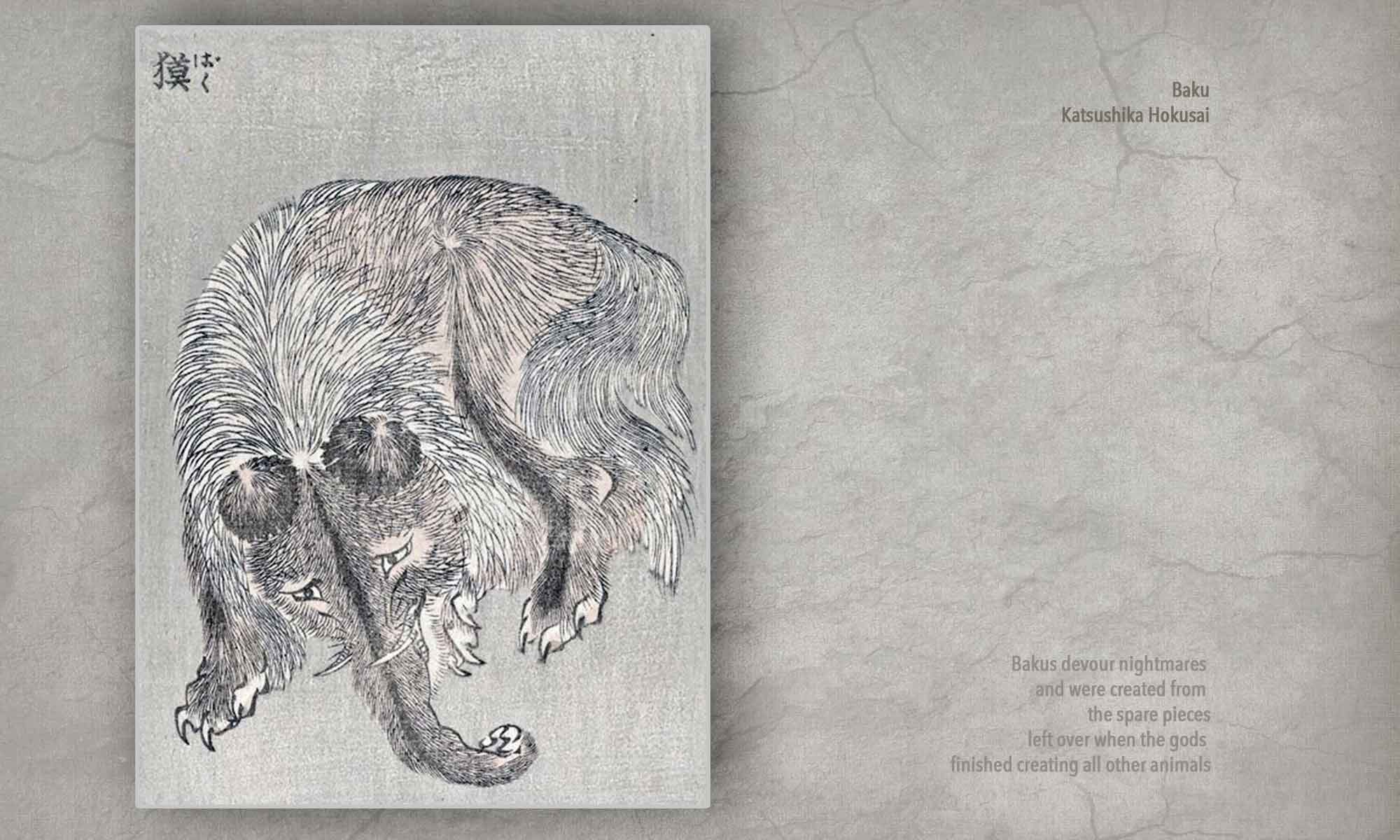

The Importance of Dreaming for Memory

It may seem hard to believe for those who rarely remember their dreams, but psychologists have found strong evidence that sleep and dreaming are closely intertwined with the dynamics of memory. Whether or not the dreams are consciously recalled in waking, the dreaming process seems to play a valuable role in the underlying system by which our memories are created, stored, and retrieved.

Researchers have discovered, for instance, that different stages of sleep support different aspects of memory consolidation, and that sleep deprivation can severely disrupt learning, memory, and other cognitive functions. According to the “ontogenetic hypothesis” of Howard Roffwarg and colleagues, the high proportion of rapid eye movement (REM) sleep in infancy and early childhood contributes to healthy brain development, which includes processing new experiences and building a foundation of primal memories. And new research by Deniz Kumral and colleagues has provided neuroscientific evidence to support the direct involvement of dreaming in the learning and memory formation process.

Dreaming of the Past

Even a brief look at the content of dreams confirms this close connection with memory. Dreams are often filled with vivid and realistically detailed images of past experiences with people, places, and activities, sometimes years or even decades later. Some past experiences, especially from childhood and adolescence, can recur in dreams throughout one’s life. These early memories become a kind of template for future dreaming, a filter through which dreams evaluate new experiences and weave them into our ongoing sense of self.  Sigmund Freud made it a cardinal principle of psychoanalytic interpretation to look for a dream’s roots in the dreamer’s memories of early childhood experiences and fantasies.

In addition to personal memories, dreams sometimes include references to family and cultural memories. Particularly in cases with traumatizing events in the communal past, the memories evoked in such dreams can be painful. However, these dreams may also provide an opportunity for generational witnessing, for keeping these sad historical truths alive in present-day awareness and documenting them for the benefit and understanding of those in the future.

Dream Journaling as a Practice of Memory

Keeping a dream journal makes it easier to remember previous dreams and track their patterns over time. Many people find it enjoyable, and even healing in a way, to review a long series of their dreams from the past and reflect on what has changed or evolved in their lives and what has remained stable and consistent. Especially in our later years, a dream journal becomes a kind of time machine that enables people to revisit the most meaningful moments and relationships from their distant past. It becomes possible in this process to discern the great arc of one’s life journey along what Carl Jung called the path of individuation, at the end of which we hopefully find a sense of wholeness and final actualization.

This is true even for those people who rarely remember their dreams. Dream recall tends to increase simply by means of an increased interest in and awareness of dreaming. In other words, the more dreams you want to remember, the more you probably will remember.


Note: this post first appeared in Psychology Today, August 11, 2025.
2025 Dream Animation Film Festival 3

The winner of this year’s “Audience Choice” award went to Daniel Rabanea for “Bends.”

Daniel described the dream that inspired his film as follows:

“I was alone on the beach. At first everything seemed calm until the sea started to look strange. A wave formed and grew bigger and bigger. My fear grew along with the dark and chaotic wave, and I thought there was no escape. But when the big wave finally hit me, something unexpected happened, the wave didn’t hit me, on the contrary, it gently caressed my face. And everything slowly calmed down. There I remained, alone on the beach, perplexed, amazed, transformed.”

And this is the process Daniel used to transform his dream into an animated film:

“I had this dream around 2010 and wrote it down in my ideas pad. Fifteen years later, the Instagram algorithm introduced me to the Dream Animation Festival. After reading the submission rules I quickly remembered my old dream and decided to make this animation. Turning the dream into animation was an adventure full of discoveries. I believed it would be a more obvious adaptation, but I discovery that dream and animation have their own particularities, the dream strongly marked by subjective sensations and the animation by objective images and sounds. During the immersive production process I was able to reflect even more on the meanings of my dream. The external, the sea that bends into waves, the chaotic nature of the universe, in connection with the internal, subjectivity, the mind building itself in bends, the dreamy nature of consciousness. The succession of events, the transformation, the devir, “you cannot step into the same river twice”.

For anyone who has experienced a dream of being menaced by an enormous tidal wave, “Bends” offers a surprising alternative to the way these dreams usually end. Daniel’s use of simple graphite drawings provides lots of space for the viewer’s imagination to fill in the subjective experience of confronting a tidal wave. For such a short film (90 seconds) it builds to a strong emotional peak and then resolves in a moment of magical transformation. No wonder the audience loved it!

2025 Dream Animation Film Festival 2

The prize for this year’s Best Animation Style went to Daniele Grosso for “The Bird Insect Tornado.”

Here is Daniele’s description of the dream that inspired the film:

“I am at a picnic on the bank of a river with some friends. I notice a flock of pinkish colored bird insects flying around a tree. I start to film them, and the flock makes a beautiful movement in the air. Their movement suddenly becomes a tornado. We pick up our things and run towards some ruins where I think we can take refuge.”

The film uses sophisticated computer-generated imagery to bring us into a three-dimensional world populated by tiny bubbles endlessly morphing in and out of various shapes and forms. Linda Koncz, the festival administrator, said this of Daniele’s work:

“The entire visuality is built on bubbles, which makes me feel as though I’m underwater, in the subconscious, and the sounds of children laughing and wind add to the dreamlike atmosphere. Each frame built of bubbles is being blown away by the wind to create the next frame, just as in dreams, the connectedness of the parts is not linear, the story fragments connect in a free associative way, like a light wave of wind…(and then gets forgotten like a mandala blown away:)”

This year’s festival asked participants to consider dreams in relation to nature and the environment, and Daniele’s film achieves this by portraying the ever-changing dynamics of human interactions with other animate creatures and with the inanimate forces of nature. The bird-insects represent one kind of unusual merging and metamorphosis; the change of the bird-insects into a tornado represents an even more dramatic transformation. The trajectory of the dream suggests we humans may find these changes increasingly unfavorable to our peace and tranquility.

2025 Dream Animation Film Festival 1

The prize for this year’s “Best Animation Narrative” went to Jessie Rodriguez for “Dreams – A Memory of Ghosts.”


This is how Jessie describes her work, which all the judges of the festival agreed is an outstanding piece of dream creativity:

“My new animation, ‘Dreams: a Memory of Ghosts,’ explores how I seem to remember my dreams in fragments, little pieces that are still with me when I wake up. Seeing the theme of climate change, I focused on bringing to life the dreams I had around animals and the earth. I have chosen an animation style of an early silent film, with intertitles as a throw back to early cinema. In this animation I have it split into three Acts, each one came from a dream. The dreams I animated all came to life from February-March of this year when I was recording them.

  • Act 1-the Council: I look through the bushes and see a procession of animals who don’t know I am there, who seem to be having a secret meeting. They turn and look at me.
  • Act 2-Cat Boxes: A house has towers of covered plastic bins going up a hundred feet in the air. They start to fall down and cats emerge from all of them. I catch some bins unsure if I should let the cats out or keep the lid on.
  • Act 3-Premium Death Package: There is an old woman sitting by her future grave. She has purchased the premium death package that allows for up to $300,000 worth of classes each year she can take once she is dead. She eagerly awaits her descent into the grave.

To share with you a little about my process, I make all of my work and films completely by hand. I work out of Denver, Colorado in the United States. My stop motion animations are created from linocut printmaking. The techniques used to make these films involve creating every visual element from scratch. Characters, textures, background and text are made by hand carving each piece out of linoleum, hand printing onto paper and then cutting out, arranging and shooting frame by frame. I employ multi-plane and other experimental techniques for each animation. I love being able to bring my ideas to life through small-scale filmmaking, and am inspired by other filmmakers who used this process such as Lotte Reininger who worked entirely with shadows and cut paper.”

Speaking for myself (and not necessarily all the other festival judges), I was completely enchanted by the oneiric atmosphere Jessie creates in her work. The retro aesthetic—hand-crafted stop-motion in an old silent film format—generated for me a very dreamy and pleasantly uncanny feeling of open imagination and an awareness that the dynamism of the past is still a living presence today. The three-dream structure invites interpretive reflections on the symbolic and emotional interplay between the separate acts of the film. Each of the three dreams touches on the festival’s theme of nature and the environment, and each one expresses some special insight about the natural world, some little koan of ecological wisdom. Thank you, Jessie!

And thanks to Linda Koncz for administering the festival and the Elsewhere.to team–Gez Quinn, Kat Juncker, Dan Kennedy, and Victoria Philibert–for their support at all stages of the process.

Reflections on An Introduction to the Psychology of Dreaming (1997)

Early in my career, I had attitude about writing “secondary” texts. I didn’t want to write about what other people thought, I wanted to write about my own ideas. That’s why when the opportunity arose to write a book intended as an introductory textbook for college students, I hesitated. The offer came by way of Sybe Terwee, a psychoanalytic philosopher from the Netherlands who had recently co-hosted the 1994 annual conference of the International Association for the Study of Dreams at the University of Leiden. Sybe had been contacted by Greenwood/Praeger, an American publisher with a large psychology catalog, asking him if he would be interested in writing an introductory text on dream psychology. He was unable to do so, but he suggested me as an alternative, and put them in touch with me. This was a big thrill for a young scholar, and I wanted to show Sybe I was worthy of his trust.
But…there was the secondary text issue. The change of mind and heart came when I recognized the creative opportunities in writing an overview of the history of modern dream psychology. As I looked at other versions of this history, and there were not many, I became increasingly confident that I could write a good, clear, multidisciplinary version of this story, whether or not it amounted to a secondary text. And then, once I got going, it was a very quick writing process. I’d say it took ten years of continuous study to be able to write the book in about three months.

As a way of orienting myself within the tremendous breadth and diversity of the field, and thus being able to explain its contours in clear terms to students new to this subject, I settled on three basic questions that I would ask at each new point in the story:

  1. How are dreams formed?
  2. What function or functions do dreams serve?
  3. Can dreams be interpreted?

These three questions give the book a tight analytic structure that makes it easy to compare similarities and differences among the various theories. To illustrate how the three questions are used going forward, I apply them in the Introduction to the ancient dream teachings found in the Bible, the philosophy of Aristotle, and the Oneirocriticon of Artemidorus. I’m trying to give readers a sense of how many of the ideas and theories of modern dream psychology did not appear out of the blue but have deep roots in the Western cultural tradition.

The order of chapters follows a by-now conventional chronology, starting with the dream theories of Sigmund Freud, then Carl Jung, then branching out into different versions of psychoanalytic psychology with a clinical focus (Alfred Adler, Medford Boss, Thomas French and Erika Fromm, Frederick Perls). Next are chapters about the findings of sleep laboratory researchers like Eugene Aserinsky, Nathaniel Kleitman, and J. Allan Hobson, and experimental psychologists like Jean Piaget, Calvin Hall, David Foulkes, Harry Hunt, and Ernest Hartmann. The last chapter is titled “Popular Psychology: Bringing Dreams to the Masses,” which chronicles the contributions of people who, beginning in the 1960’s and 1970’s, expanded the horizons of dream psychology both in the way they practiced dream interpretation (in group settings, not just in psychiatric sessions or sleep labs) and in the dreamers they included (all people in all cultures, not just Western therapy patients). This chapter profiled the work of Ann Faraday, Patricia Garfield, Gayle Delaney, Jeremy Taylor, Montague Ullman, Stephen LaBerge, and ends with the “Senoi Debate” between Kilton Stewart and G. William Domhoff.

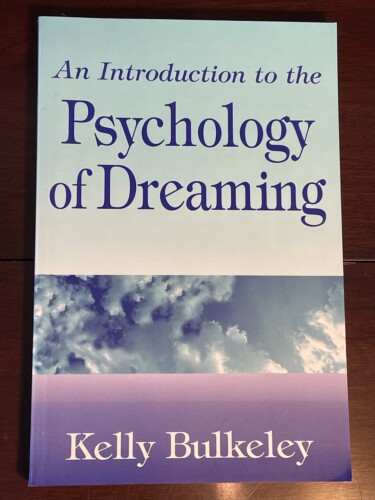
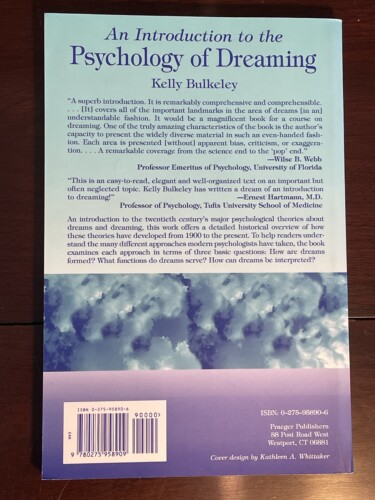
The cover was entirely out of my hands. It’s fine, I’ve come to like the blue-to-indigo colors and the cloudy sky imagery, it’s all rather trippy. We persuaded two eminent sleep laboratory researchers, Ernest Hartmann and Wilse Webb, to write back-cover endorsements. Hartmann and Webb were both in the first generation of psychologists who studied how the new findings about REM and NREM sleep relate to psychoanalytic insights about the nature of dreaming. If they were happy with the book, then mission accomplished.

Reflections on Among All These Dreamers (1996)

The first time I attended an annual conference of the International Association for the Study of Dreams was in Santa Cruz in 1988. For the next several years (London in 1989, Chicago in 1990 (which I hosted), Charlottesville, Virginia in 1991) these conferences gave me an opportunity to learn more about the various ways in which people were exploring the origins, functions, and meanings of dreaming. One thing that struck me right away was that several people were looking at dreams not only as a source of personal insight but also as a source of insight into collective issues and concerns. Based on my own studies so far, this seemed like an important idea for dream researchers to develop further, even if it ran counter to the predominantly individualistic approach of most psychologists at that time.
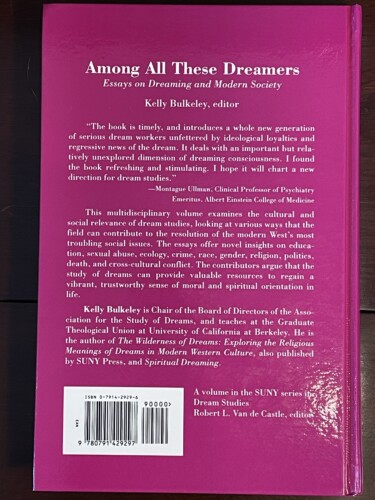
Inspired by these colleagues at the IASD, I put together an edited book, Among All These Dreamers: Essays on Dreaming and Modern Society, which was published in 1996 by State University of New York (SUNY) Press as part of the Series in Dream Studies edited by Robert Van de Castle. Each of the chapters is a written version of material presented at an IASD conference and shaped by those conversations. Here are the chapter titles:

  1. Dreams and Social Responsibility: Teaching a Dream Course in the Inner-City –Jane White-Lewis
  2. The 55-Year Secret: Using Nightmares to Facilitate Psychotherapy in a Case of Childhood Sexual Abuse – Marion A. Cuddy & Kathryn E. Belicki
  3. Seeking the Balance: Do Dreams Have a Role in Natural Resource Management? – Herbert W. Schroeder
  4. Reflections on Dreamwork with Central Alberta Cree: An Essay on an Unlikely Social Action Vehicle – Jayne Gackenbach
  5. Black Dreamers in the United States – Anthony Shafton
  6. Sex, Gender, and Dreams: From Polarity to Plurality – Carol Schreier Rupprecht
  7. Traversing the Living Labyrinth: Dreams and Dream-Work in the Psychospiritual Dilemma of the Postmodern World – Jeremy Taylor
  8. Invitation at the Threshold: Pre-Death Spiritual Experiences – Patricia Bulkley
  9. Western Dreams about Eastern Dreams – Wendy Doniger
  10. Political Dreaming: Dreams of the 1992 Presidential Election – Kelly Bulkeley
  11. Healing Crimes: Dreaming Up the Solution to the Criminal Justice Mess – Bette Ehlert
  12. Let’s Stand Up, Regain Our Balance, and Look Around at the World – Johanna King

The conclusion presents what I consider a “Soc. 2 Manifesto,” drawing upon ideas developed during the teaching I did at the University of Chicago from 1989 to 1993 in the yearlong Social Sciences core sequence titled Self, Culture, and Society (Soc. 121-121-123), commonly known as Soc. 2. Max Weber’s notion of the disenchantment of the modern world is a central notion here, which I believe casts a new and more urgent light on the cultural value of dreaming and its innately spiritual qualities.

The title came to me in a flash. One day while working on the book I thought, maybe I could use a phrase from Nietzsche. I stood up, took The Gay Science from my bookshelf, flipped it open, and almost immediately landed on Aphorism 54 and the following paragraph:

“Appearance for me is that which lives and is effective and goes so far in its self-mockery that it make me feel that this is appearance and will-o’-the-wisp and a dance of spirits and nothing more—that among all these dreamers I, too, who ‘know,’ am dancing my dance; that the knower is a means for prolonging the earthly dance and thus belongs to the masters of ceremony of existence; and that the sublime consistency and interrelatedness of all knowledge perhaps is and will be the highest means to preserve the universality of dreaming and the mutual comprehension of all and thus also the continuation of the dream.” (translation by Walter Kaufman, emphasis in original)

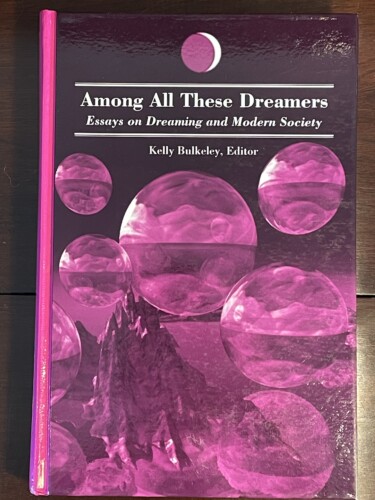
The book’s cover was not my design, although I’m okay with the trippy interplanetary image and vibrant magenta color. The SUNY Series in Dream Studies had a house style they wanted each new book to use, and that’s what we did here. The back cover endorsement from Montague Ullman was especially appreciated since he is one the true pioneers in the application of dream interpretation methods to group programs for community mental health.