Lucid Dreaming and “Pan’s Labyrinth”

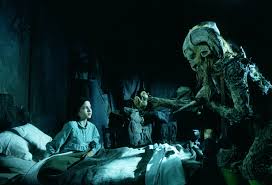
Ofelia in bedThis essay is based on a presentation I gave at the Oregon Museum of Science and Industry on April 13, 2016, as part of OMSI’s “Reel Science” series in which a lecture precedes the showing of a popular movie. My lecture involved the science of lucid dreaming, and the film was Guillermo del Toro’s “Pan’s Labyrinth” (2006).

A simple definition of lucid dreaming is this: the experience of consciousness or self-awareness within the dream state. Sometimes it includes a greater sense of intentionality or control—the dreamer has some ability to change or alter what’s happening in the dream.

Here are some statistics about the frequency of lucid dreaming among the general population, drawn from the two-volume anthology Ryan Hurd and I edited in 2014, Lucid Dreaming: New Perspectives on Consciousness in Sleep.

  • More than 50% of the population has had at least one dream of lucid awareness
  • Gender: slightly higher frequencies for females
  • Age: much higher frequencies (70%-80%) in early adulthood, then a drop-off over time
  • Higher frequencies for religious “nones,” political liberals, and people living in Western US
  • No major differences on other demographic variables

We also have some research on the content of lucid dreams, and what makes them distinctive from ordinary dreams. In general, lucid dreams are not radically different from ordinary dreams; they both share the same basic substrate of dreaming experience. In this sense lucid dreaming is an extension of what’s already going on in ordinary dreaming. We do not need to invoke a separate psychological system to explain what happens in lucid dreaming.

That being said, the few differences are illuminating. Lucid dreams have more references to:

  • Awareness
  • Effort
  • Flying
  • Fantastic beings
  • Physical aggression

Lucid dreams have fewer references to:

  • Colors
  • Speech
  • Family characters
  • Friendly social interactions

These are tendencies, not absolutes, so they don’t apply to every individual experience. But they make sense in that lucidity often emerges during nightmares (physical aggression) or when the individual encounters something bizarre or anomalous (flying, fantastic beings), and the dreams often do lead away from the normal social world into strange, unfamiliar places.

The frequency of lucid dreaming is not set in stone. As several researchers have found, gaining conscious awareness in dreaming is an ability that may first appear spontaneously, but can also be trained like a cognitive skill, and guided with some degree of precision.

In the past few years a number of electronic devices have been invented and marketed as tools for lucid dream induction, with several more such devices in development.

These devices represent high-intensity and rather aggressive approaches to lucid dreaming. They can get results, at least for some people. But I wouldn’t recommend them for use before considering some of the other methods we’ll discuss towards the end.

Let’s step back for a moment and acknowledge the fact that lucid dreaming may be a new phenomenon to modern Western society, but it has a long and venerable history in many other cultures.

Going back to the 7th century BCE, the Upanishads of Hinduism referred to dreaming as a space of infinite illusions where the skilled meditator was able to recognize the self-created nature of dream reality. This insight in dreaming was considered a key step toward recognizing the self-created nature of all reality, in all states of being.

Zhuang Zi, the Daoist sage from the 4th century BCE, in addition to his famous parable of the dream of the butterfly, had this to say about dreaming in general: “After we’re awake, we know it was a dream—but only after a great awakening can we understand that all of this is a great dream.”

Buddhism is filled with teachings about lucid dreaming. The twelfth century CE Tibetan Buddhist master Naropa developed a systematic method of inducing lucid dreams. Significantly, the teachings about dreams began after the student had mastered the earlier teachings on Inner Heat and the Illusory Body. In this tradition the entry into lucid dreaming occurred within a well-developed context that helped the student safely process the potentially destabilizing effects of deliberately altering the functions of one’s mind.

In classical Western antiquity, Aristotle in the 4th century BCE mentioned dreams in which people had some knowledge of being in a dream state. And in the 4th century CE the Christian theologian Augustine used the example of lucid dreams as a way of arguing for the reality of the soul and its independent existence apart from the body, in sleep or in death and the afterlife.

In Islam, Muhammad’s “night journey” in sura 17 of the Qur’an has many aspects of a lucid dream. Sufi Muslims to this day engage in lucid dreaming practices as a means of learning esoteric spiritual doctrines.

This could go on, of course, but let me mention one more example. It comes from anthropologist Diana Riboli, whose studies of indigenous cultures in Nepal and Malaysia found that shamanic healers used lucid dreaming not only to heal people, but also to challenge, battle, and even kill enemy shamans. (Her work appears as chapter 4 in volume 2 of the Lucid Dreaming anthology.) As Riboli observed, the dueling shamans

“fight in the course of violent and dramatic dreams during which they feel themselves to be totally conscious and able to interact with the other individual. These lucid dreams can continue for days and even weeks, coming to an end only when one of the rivals dies, both in the dream and in everyday life.”(74)

So that’s a good reminder that amidst all the positive spiritual insights of lucid dreaming, there is also a destructive potential where the enhanced abilities of consciousness can become weaponized and used in violent efforts to defeat a rival.

All of these historical and cross-cultural references do more than just embroider the edges of scientific research. They reveal an important fact about human psychology: people in virtually all cultures and civilizations have recognized that lucid dreaming is a valuable potential of the sleeping mind. This is evidence that a capacity for self-awareness in dreaming is innate in the mental architecture of our species.

It has taken modern Westerners a while to get there, but now researchers are working diligently to gather solid empirical data to support this historical insight. Here are the few things we know with some confidence:

Variations in occurrence: Lucid dreaming can occur in REM sleep and threshold phases between waking and sleeping (e.g., hypnogogic and hypnopompic states).

Variations in metacognitive abilities: There are multiple dimensions of lucidity, involving the emergence in dreaming of high-level mental abilities we usually associate with waking consciousness, such as reflecting, evaluating, doubting, judging, and planning. These kinds of complex mental abilities are known as “metacognition,” or “thinking about thinking.” The dream world turns out to include a much wider variety of metacognitive activities than Western psychologists have long assumed.

Neurologically plausible: We don’t know for sure how exactly lucid dreaming maps onto the various cycles of brain activity during sleep.  However, we do know that many brain systems crucial to waking consciousness are also prominent in sleep, particularly in REM sleep. This includes activities in the prefrontal cortex, rising levels of neurotransmitters like acetylcholine, and electrical bursts in the alpha and beta/gamma frequencies. The presence in sleep of these neural factors, so crucial to consciousness in waking, makes it plausible that, given the right circumstances, a high degree of self-awareness could emerge within the sleep state.

Comparable to meditation: There is considerable overlap in the neurological and behavioral features of lucid dreaming and various kinds of meditation. Both involve high levels of attention, arousal, and internal focus, and in both the body remains motionless and detached from the external world.

So the discussion comes full circle, as modern brain scanning technologies are validating experiences that ancient practitioners have long recognized and actively cultivated.

And this means that both science and religion agree on a basic idea: what’s possible in dreaming depends on the dreamer’s frame of mind. Here’s a quote from a lucid dreaming study performed several years ago by psychologist Sheila Purcell and her colleagues at Carleton University:

“The present results indicate that the inhibitory constraints on this process are implicit in the organization of the dreamer rather than the dreaming. The lifting of these constraints, their reorganization, can be effected through the mechanisms of attention and intention on what is to be reorganized. The constraints on this response are therefore not implicit in dreaming itself, although this view of dreaming has been widely held.” (Purcell et al. 247)

This is a dramatic claim, even though it’s couched in academic language. The upper limits of metacognitive dreaming are set by the individual’s mental framework, not by the capacities of dreaming itself. These limits can be changed if the mental framework is changed. People can have more lucidity in their dreams if they strive to do so, through greater attention (learning how to monitor consciousness) and intention (learning how to concentrate one’s mental energies).

Hi-tech gizmos can help, but ancient and modern research agrees that the key to increasing lucidity in dreaming is the combined force of attention and intention.

In this context, it’s worth mentioning Ryan Hurd’s lucid dreaming talismans, which are low-tech but quite effective aids to enhancing lucid dreaming. The talismans are aesthetically attractive mnemonic devices designed to apply the same basic principles of attention and intention advocated by Purcell and her colleagues.

Now let’s turn to lucid dreaming and film. The general history of dreams and movies and their dynamic interplay is fascinating in itself, but for now I’ll focus on the subgenre of movies specifically about or related to lucid dreaming. In a chapter Bernard Welt and I wrote for the Lucid Dreaming anthology, our top seven list included these films (framed by a lengthy discussion of the theoretical and methodological issues involved in analyzing films with psychological categories):

  • Peter Ibbetson (1935)
  • Dead of Night (1945)
  • Dreamscape (1984)
  • A Nightmare on Elm Street (1984)
  • The Matrix (1999)
  • Waking Life (2001)
  • Inception (2010)

In a shift from many other Hollywood films (for example, Alfred Hitchcock’s 1945 “Spellbound”) which treat dreams as symbolic puzzles requiring psychoanalytic interpretation, these seven movies present dreaming as kind of a portal to higher consciousness. They are fantasy and science fiction stories, each of which presents lucid dreaming as a means of seeing through not only personal illusions, but collective illusions as well.   As Bernard and I say in our book chapter, “the movies exploit the idea that lucidity may be the only means of escape from, or transcendence beyond, an imaginary but collective mindset that completely controls the subjective experience of the dreamer in the waking world.”
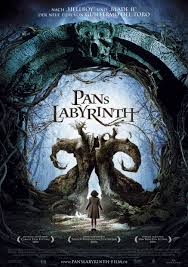
poster Which brings us to “Pan’s Labyrinth.” Guillermo del Toro’s 2006 film is not purely fantasy or science fiction, but rather a surrealist fairy tale folded into a wartime drama. Maybe it should be called “historical horror.”

The opening lines of the film frame it as a kind of lucid dream gone awry:

“[Pan:] A long time ago, in the underground realm, where there are no lies or pain, there lived a princess who dreamed of the human world. She dreamed of blue skies, soft breeze, and sunshine. One day, eluding her keepers, the Princess escaped. Once outside, the brightness blinded her and erased every trace of the past from her memory. She forgot who she was and where she came from.”

Thus begins the story of Ofelia (Ivana Baquero), a 12-year old girl whose mother Carmen (Ariadna Gil) has remarried after the death of Ofelia’s father. Her new husband is Captain Vidal (Sergi Lopez), the cruel commander of an army unit tasked with hunting down the last few resistance fighters hiding in the mountains after the Spanish Civil War. Carmen is pregnant with Captain Vidal’s child, and Ofelia quickly realizes that her step-father cares nothing for her or her mother, only the baby. Ofelia’s entry into the labyrinthine world of Pan (Doug Jones) is driven by a desperate need to find some way of fighting against the overwhelming horror of her waking world.
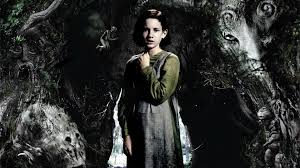
OfeliaThe fantasy sequences with Ofelia have some striking similarities with the typical content patterns of lucid dreams, as mentioned earlier. Here’s how I summarized the research findings a few minutes ago:

Lucid dreams have more references to awareness, effort, flying, fantastic beings, and physical aggression, and fewer references to colors, speech, family characters, and friendly social interactions.

Ofelia’s journeys into the labyrinth are distinguished from the rest of the film by many of these same features. She is aware of things no one else can see. She makes tremendous efforts to succeed in the tasks set her by the Faun.   Her first encounter with the fantastic beings of the labyrinth is a winged fairy, a flying agent of Pan’s who accompanies and guides Ofelia wherever she goes. Her fantasies are filled with physical aggression (although sadly no more so than her waking world).

Intriguingly, the fantasy sequences have much less color than the waking world scenes; there’s little emphasis in the labyrinth on chromatic perception. There’s also less speech, no other family characters (until the end), and very few friendly interactions.

All in all, very much like the experience of a lucid dream. When Ofelia enters the labyrinth, she enters a world that’s closely akin to the realm of conscious dreaming.
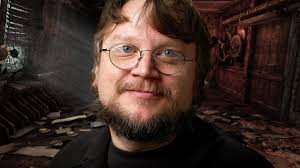
GDTAs it turns out, there is a good biographical reason for this. In interviews he gave at the time of the film’s release, del Toro described his own childhood experiences of “lucid nightmares” in which he saw the figure of the Faun stepping out from behind a dresser at midnight.   He had recurrent dreams of many kinds of monsters, but the Faun made an especially horrifying impact on him. In the film del Toro aims to recreate this powerful fantasy figure who stalked his own personal nightmares.

Here is an excerpt from an interview he gave in 2006 to Ain’t It Cool News:

Q: Did you, in fact, have such nightmares or waking nightmares?

GDT: Many, many of them… When I was a kid, when I slept in the guest bedroom of my grandmother’s house, at midnight, a faun would come out from behind the dresser. And I know it was lucid dreaming, I know it must have been…

Q: Do you remember, did your faun look anything like the faun in the film?

GDT: Absolutely. I was trying to recreate him.
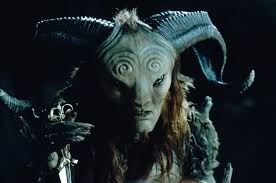
PanWhen del Toro referred to these dreams as “lucid” he seemed to mean they had all the qualities of waking reality, and yet he knew they were dreams because of the appearance of Faun or other creatures. It’s not that he was dreaming, then realized he was awake within the dream; rather, he felt like he was awake, while also realizing he must be dreaming. Both are paths to lucidity, but the latter can be much more frightening and existentially unsettling.
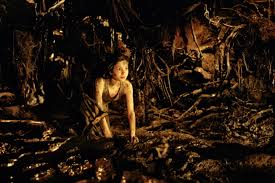
muckThis helps to explain at least some of the uncanny impact of “Pan’s Labyrinth.” Guillermo del Toro knows from deep personal experience the feelings of dread and terror associated with the darker path into lucidity. He knows that if you are already dreaming and then become self-aware, your conscious self feels powerful and expanded. But if you realize what you thought was waking reality is actually a dream, that’s a much more threatening mode of lucidity, a lucidity of weakness, vulnerability, and deception. A lucidity of horror.

In “Pan’s Labyrinth” del Toro inverts the typical path into conscious dreaming and thrusts Ofelia and the audience into shadowy, oozing realms of oneiric fantasy few other directors have had the daring or talent to explore.
 

Cartoon Dreams: Psychological Insights in The Justice League and SpongeBob SquarePants

imgresChildhood is a time of frequent and intense dreaming for many people. Often these nocturnal experiences from early life have a dark hue—children are especially prone to nightmares, sleep paralysis, and night terrors. But children are also more likely than adults to experience magical dreams of flying and lucid dreams of self-awareness.   The whole wild world of dreaming, in all its strange complexity, seems more accessible in childhood than it is later in life.

A rich tradition of children’s literature, going back to such classics as Alice in Wonderland, Goodnight Moon, and Where the Wild Things Are, has addressed the profound feelings of fear, wonder, and curiosity that often pervade children’s experience when they go to sleep and dream. Cartoons are another powerful medium that can reflect recurrent themes in childhood dreams (good examples include Little Nemo in Slumberland, Dream of the Rarebit Fiend, and the Sandman series).

Cartoons on television have carried on this tradition, telling stories about dreams with much more psychological depth and power than many adults realize. These animated fictions about bizarre characters doing absurdly unrealistic things turn out to reflect the emotional reality of childhood with surprising accuracy and psychological insight.

Two episodes from recent cartoon series can help to illustrate the point.

imgres-1The first comes from “SpongeBob SquarePants,” which first aired in 1999 on the Nickelodeon network and has gone on to become one of the most popular cartoons of all time.   An episode in season 5, titled “Roller Cowards,” features dreaming as a valuable source of self-knowledge. The episode opens with Sponge Bob and his best friend Patrick hearing about an amazing new roller coaster ride (“The Fiery Fist O’ Pain”) at their favorite amusement park. The night before they go to the park, Sponge Bob goes to sleep thinking about how much fun the ride will be. But then he has a nightmare in which the roller coaster leads to terror and death, and he wakes up trembling in fear. When Patrick comes over and asks what’s wrong, Sponge Bob says he just had a bad dream. Patrick quickly says he had a bad dream, too. Sponge Bob asks what he dreamed, but before Patrick can answer the bus arrives to take them to the amusement park, and away they go.

It turns out Patrick is just as scared as Sponge Bob, though neither of them wants to admit their fears to the other. Their dreams provide accurate barometers of how they really feel, despite all their conscious efforts to pretend otherwise. Only when they finally make the humbling confession to each other that they’re scared to go on the ride, are they ready to embrace the thrilling, spine-dislocating experience of the “Fiery Fist.”

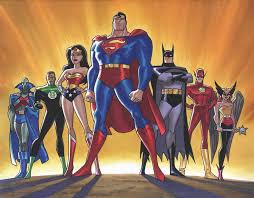
A second example comes from the “Justice League” series, which first aired in 2001 on Cartoon Network. Based on characters from DC Comics, the series gathers seven famous superheroes—Batman, Superman, Wonder Woman, Green Lantern, Flash, Hawkgirl, and J’onn J’onzz—who battle a colorful variety of super villains. The second season presented a two-part episode titled “Only a Dream,” featuring a criminal named John Dee who uses an ESP-generating machine to transform his own brain into a powerful weapon that can attack people in their dreams. After murdering his faithless girlfriend, Dee—who has now taken on the nom de guerre of Dr. Destiny—focuses his evil power on the members of the Justice League when they fall asleep and dream.

This is where the cartoon enters more sophisticated psychological territory. Dr. Destiny attacks each superhero at his or her weakest point, namely what they fear the most. This fear gives shape to the kind of nightmare that Dr. Destiny sends to each of them.

For the super-speedy, wisecracking Flash, his nightmare involves never being able to slow down, so he can never again connect with normal people; as Dr. Destiny intones, his dream prison is “being stuck in high gear, alone forever.” In Superman’s nightmare he cannot control his increasingly destructive powers, which he tries to hide but cannot. His greatest fear is that his power will hurt the very people he cares about the most. The Green Lantern dreams that he goes back to his old neighborhood, but he recognizes nothing, and everyone speaks a different language. When people see him they flee from in terror; like the Flash and Superman, his deepest anxiety has to do with staying connected with other people despite his special powers and unique identity.

imagesHawkgirl’s dream is perhaps the most intense and frightening of all. After a false awakening that gives her a moment of deceptive reassurance, Dr. Destiny binds her wings and sends her plunging down to earth, straight into a yawning grave in which she is buried alive under a mound of dirt. For a superhero whose special power is flight, this would be a terrifying nightmare indeed.

Batman, meanwhile, has managed to stay awake, but barely. Dr. Destiny haunts the periphery of his sleep-deprived consciousness, nearly causing him to crash the Batmobile.

Fortunately for the Justice League, J’onn the Martian Manhunter has the ability to go into people’s dreams and help their dreaming selves fight back against Dr. Destiny. J’onn serves as a kind of shamanic warrior and therapist, telling each of the superheroes what he or she needs to hear to rally their strength and break free of their nightmare. Each of them alone cannot defeat Dr. Destiny. But once they find new sources of strength within their dreams, the collective might of the Justice League (sans Wonder Woman; she does not appear in this episode) is enough to overthrow Dr. Destiny and his Freddy Kruger-like reign of terror over their slumber.

And finally, Batman can sleep.

The Justice League episode is much more psychologically complex than the one from SpongeBob SquarePants, which is befitting given the latter show’s focus on younger children and the former’s appeal to older children and tweens. Both cartoons, however, present a similar appreciation for dreaming as a means of expressing important emotional truths, especially those truths that seem most frightening to our waking minds. In the world of these two cartoons, dreams are portrayed as a valuable source of insight. Without putting too much weight on stories meant primarily as entertainment, it’s still fair to say that the resolution of each story teaches a basic respect for the power and wisdom of dreaming.   These cartoons have, perhaps unwittingly, done a wonderful service of dream education for millions of children.


This essay first appeared in the Huffington Post on Feb. 18, 2016.


Tolkien’s Dreams, Past and Future

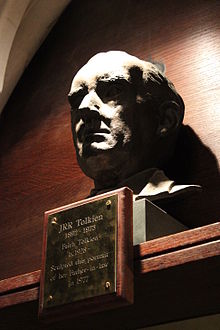
220px-Oxford_TolkienDreams play a significant role in The Lord of the Rings, J.R.R. Tolkien’s multi-part fantasy story written in the first half of the 20th century.  The dream elements become muted in Peter Jackson’s film adaptation, but in the novels they serve as an important source of insight for the characters.  According to Curt Hoffman in “Wings over Numenor: Lucid Dreaming in the Writing of J.R.R. Tolkien,” the dreams in the stories were modeled in many cases after Tolkien’s own dream experiences.  For instance, the Middle Earth legend of Numenor, a western land that was destroyed by a vast ocean wave, apparently derives from Tolkein’s personal “Atlantis Complex” and his recurrent dreams of huge, all-consuming waves.

Hoffman’s chapter appears in Lucid Dreaming: New Perspectives on Consciousness in Sleep, which Ryan Hurd and I edited for ABC-Clio.  Hoffman explains that the most remarkable story Tolkien ever wrote about dreams was also the only story he ever wrote set in the future, not in the past.  Titled “The Notion Club Papers,” Tolkien started it in 1946 but never finished the manuscript.  Hoffman says,

“The work purports to be the minutes of the fortnightly meetings of an Oxford literary society, the Notion Club (obviously a gloss for the Inklings [Tolkien’s actual literary club], although there is little one-for-one correspondence to its members), between 1980 and 1990. The manuscript’s conceit is that the papers “were found after the Summer Examinations of 2012, on the top of one of a number of sacks of waste paper in the basement of the Examinations Schools at Oxford by the present editor,” and it is represented to have been published in 2014.” (133)

Tolkien creates a strangely forward-telescoping, prospectively recursive way of framing the story—he writes about events that happen 40 years in the future, which are then discovered 20+ years after that, and are then published two years after that (at a time that happens to be our present).

In the story the club members engage in lengthy discussions of dreaming as a means of space and time travel, along with various accounts of strange adventures in thought and consciousness.  Without warning the discussion turns rather apocalyptic, as several club members describe visions that portend the coming of cataclysmic storms.  The manuscript breaks off there, and Tolkien never went back to it.  After careful study of this work, Hoffman concludes,

“It is entirely unclear what purpose Tolkien had in producing the Notion Club Papers, but his publishers were pressuring him at the time to get back to the writing of The Lord of the Rings, for obvious economic reasons, and this may explain why he did not finish the work. He never returned to it, and its status remains mysterious to this day. However, it is the clearest indication we have in all his writing of his interest in a variety of dream states and their relationship to waking physical reality. In particular, even though there is no evidence that he was aware of the writings of van Eeden on lucidity, it seems that Tolkien had a strong interest in lucid dreaming, based upon his own personal experience, and that he was attempting to put this into some kind of formulation in words that would make his experience more understandable, at least to his fellow Inklings.” (138)

Robots Dreaming

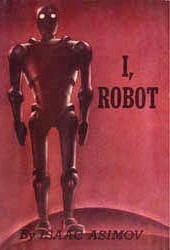
I_robot“I, Robot” (2004) is a movie about visions of the future that are haunted by dreams from the past.  Loosely based on Isaac Asimov’s classic sci-fi stories from the 1940’s, the film opens in 2035 with a harrowing nightmare that graphically repeats, PTSD-style, an accident suffered by homicide detective Del Spooner, played by Will Smith.  Several cars crashed and plunged into the Chicago River, and a robot dove into the water and rescued Spooner but not a little girl, whose chances of survival the robot deemed too low to justify trying to save.  After the agonizing experience of watching the girl sink down into the watery depths while he was lifted up to safety, Spooner becomes bitterly suspicious of all modern technologies and distrustful of claims that “intelligent” robots can improve human life.  Wearing his black leather trench coat and old-school Converse hi-tops like battle armor, Spooner is a man defiantly out of step with the march of cybernetic progress.

And then he gets a case that seems tailor made for his neo-Luddite paranoia: the first instance of a robot murdering a human.  Of course the case turns out to be much more than it first appears, and Spooner is gradually drawn into a deeper mystery about the nature of robots, humans, and the future of their relations.  At the center of the mystery is another dream—the dream of a robot.

The murder victim is Dr. Alfred Lanning (James Cromwell), a robot designer and a friend of Spooner’s.  The robot who apparently killed Dr. T. is named “Sonny” (Alan Tudyk), and Spooner finds that Sonny is far more personable than any other robot he’s ever seen, with emotions, existential questions, and a capacity to dream.

Spooner asks Sonny to describe his dreams, and the robot uses both hands to rapidly sketch an image of a large broken bridge, with a vast crowd below looking up at a single figure standing alone on a hill near the bridge.  Sonny says the single figure in the dream is going to liberate the crowd below from their oppression.  Dr. Susan Calvin (Bridget Moynahan), a colleague of Dr. Lanning who is also Spooner’s new love interest, suggests the lone figure might be Sonny himself.  Sonny considers that possibility, trusting humans to know more about the patterns of dreaming than he does.  But he also says he had the impression the liberating figure in the dream is Spooner.

Without giving away the whole plot, it can be noted that both interpretations of Sonny’s dream are true in some measure.  The climactic scenes of the movie take place near the broken bridge, so the dream has a prophetic, future-predicting quality to it.  The dream provides vital clues necessary to solve the mystery of Dr. Lanning’s death, it anticipates the character development of both Sonny and Spooner, and it heralds a revolutionary shift in robot-human interactions.  As with all “big dreams,” it has multiple levels of meaning and significance that play out across different timescales.

The ending of the film wraps up all the narrative threads, but it leaves the audience with an unsettling question.  If robots can really dream, what else might they envision about our collective future?  My guess is, it probably won’t be limited to fantasies of electric sheep.

The Dream Logic of Twin Peaks

Fan Phenomena Twin PeaksA cool new book has just been published, with special appeal to David Lynch fans.  Fan Phenomena: Twin Peaks, edited by Marisa C. Hayes and Franck Boulegue, was released this month by Intellect Books in the UK.  Other titles in the Fan Phenomena series include Star Wars, Buffy the Vampire Slayer, Dr. Who, and Batman.  We’re in great company!


Here’s a passage from the editors’ introduction: “When we refer to a show’s impact within the realm of fan phenomena, we move far beyond the game of numbers that determines the initial airtime of any given series.  The shows and films that persevere do so because they strike a chord within a dedicated, passionate group of followers.  Such programmes are often rejected by mainstream audiences or studios for being too ‘inaccessible,’ ‘offbeat,’ or ‘controversial,’ as witnessed with Twin Peaks.  The show’s vibrant and richly layered dream sequences, for instance, resemble what general audiences might stereotypically expect to find at a video art exhibition, not on network television.  Yet, it is often these very elements that are credited with building and extending a show or film’s lasting cult following.”

My chapter in the book has to do with the portrayal of dreams in the initial episodes of the series, especially Agent Cooper’s dream at the end of the third episode.  Apparently the ratings numbers went down precipitously right after this episode!  Too weird for some people, but a breath of fresh air for many others.

Other chapters in the book include “Peaks and Pop Culture” by Shara Lorea Clark, “Audrey in Five Outfits” by Angela K. Bayout, “Embodiment of the Mystery: Performance and Video Art Go Twin Peaks” by Gry Worre Hallberg and Ulf Rathjen Kring Hansen, “The Owls Are Not What They Seem: Cultural Artifacts in Twin Peaks” by Andrew Howe, “‘Yeah, But the Monkey Says, Judy’: A Critical Approach to Twin Peaks: Fire Walk With Me” by Scott Ryan and Joshua Minton, “Twin Peaks and the ‘Disney Princess’ Generation” by David Griffith, “Bond on Bond: Laura Palmer and Agent Cooper in Twin Peaks” by David Bushman, “Strange Spaces: Cult Topographies in Twin Peaks” by Fran Pheasant-Kelly, and “Gothic Daemon BOB” by Chris Murray.


Penelope and Odysseus: The Perils of Dream Interpretation

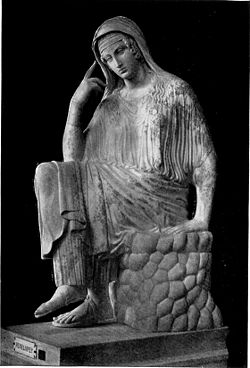
250px-Penelope_-_Homers_Odyssey_-_Project_Gutenberg_eText_13725


I’d like to illustrate some basic principles of dream interpretation by telling a story. It’s a very old story, one you may have heard before, but I’d like to tell it again because even though it’s “just a story” it highlights the real perils that come when these dream interpretation principles are overlooked.

The story has to do with the meeting of Odysseus and Penelope in Book 19 of The Odyssey. In many respects this encounter is the point of greatest dramatic intensity in the entire poem, and at the heart of the scene is a dream-Penelope’s dream of the twenty geese that are suddenly slaughtered by a mountain eagle. Odysseus, after leading the Achaean army to victory against the Trojans and after enduring a seemingly endless series of trials and adventures, has returned at last to his island home of Ithaca, where he has found a mob of rude noblemen besieging his palace. The crafty warrior has disguised himself as an old beggar in order to gain entrance into the palace without being recognized, and he is plotting violent revenge against the men who would steal his throne. Penelope, who for many years has desperately clung to the hope that Odysseus would someday return to her, has invited this strange wanderer into her private chambers to ask if he can tell her any news of her husband. The beggar fervently promises the Queen that Odysseus is very close and will return very, very soon. Penelope replies to the beggar’s story by saying she wishes his words would come true, but she doubts they will. She then asks her old servant woman, Eurycleia, to bathe the stranger and arrange a comfortable place for him to sleep. The Queen steps away while the old nurse washes the beggar’s feet. Then, before parting for the night, Penelope returns to the beggar and says (all quotes are from the translation of Robert Fagles, 1996, Viking Press),

“My friend, I have only one more question for you….
[P]lease, read this dream for me, won’t you? Listen closely….
I kept twenty geese in the house, from the water trough
They come and peck their wheat-I love to watch them all.
But down from a mountain swooped this great hook-beaked eagle,
Yes, and he snapped their necks and killed them one and all
And they lay in heaps throughout the hall while he,
Back to the clear blue sky he soared at once.
But I wept and wailed-only a dream, of course-
And our well-groomed ladies came and clustered round me,
Sobbing, stricken: the eagle killed my geese. But down
He swooped again and settling onto a jutting rafter
Called out in a human voice that dried my tears,
‘Courage, daughter of famous King Icarius!
This is no dream but a happy waking vision,
Real as day, that will come true for you.
The geese were your suitors-I was once the eagle
But now I am your husband, back again at last,
About to launch a terrible fate against them all!’
So he vowed, and the soothing sleep released me.”
(The Odyssey 19.575, 603-621)

The disguised Odysseus immediately replies,
“Dear woman,….twist it however you like,
Your dream can mean only one thing. Odysseus
Told you himself-he’ll make it come to pass,
Destruction is clear for each and every suitor;
Not a soul escapes his death and doom.”
(The Odyssey 19.624-629)

Penelope’s response to the beggar is this:
“Ah my friend, seasoned Penelope dissented,
Dreams are hard to unravel, wayward, drifting things-
Not all we glimpse in them will come to pass….
Two gates there are for our evanescent dreams,
One is made of ivory, the other made of horn.
Those that pass through the ivory cleanly carved
Are will-o’-the-wisps, their message bears no fruit.
The dreams that pass through the gates of polished horn
Are fraught with truth, for the dreamer who can see them.
But I can’t believe my strange dream has come that way,
Much as my son and I would love to have it so.”
(The Odyssey 19.630-640)

So, what has just happened here? What is going on between Odysseus and Penelope, and what is the significance of her dream and their exchange about its meaning? The traditional interpretation of this scene, shared with near unanimity by scholars from antiquity to the present, is this. Odysseus has heroically controlled his desire to rejoin Penelope and hidden his identity from her for two reasons: one, to test his wife’s fidelity during his long absence (remember Agamemnon and Clytemnestra), and two, to pick up information about how to destroy the hated suitors. Penelope’s dream of the 20 geese is a straightforward prophecy, whose true meaning the disguised Odysseus instantly recognizes. But Penelope, who has shown a stubborn skepticism throughout the story, refuses to accept the dream’s obvious meaning. Indeed, perhaps she unconsciously enjoys the attention of the suitors and does not really want Odysseus to come back.

My dissatisfaction with this widely held interpretation centers on its strange depreciation of Penelope’s intelligence. This is a woman whom several characters have praised for her unrivalled perceptiveness, cunning, and guile; this is the woman who devised the famous ruse of the funeral shroud, by which she successfully deceived the suitors for three years. All of the evidence in the poem makes it clear that Penelope is not a fool: she is extremely perceptive and capable of remarkably subtle deceptions. So why, when we come to Book 19 and her meeting with the “beggar,” should we now forget all that and regard Penelope as a pathetically unwitting dupe in the vengeful scheming of Odysseus?

Here is the moment when careful reflection on Penelope’s dream can open up new horizons of meaning. The Iliad and The Odyssey together contain, up to the point of Penelope’s dream of the 20 geese, four major dream episodes: Agamemnon’s “Evil Dream” from Zeus (2.1-83), Achilles’ mournful dream of the spirit of dead Patroklos (23.54-107), Penelope’s reassuring dream from Athena (4.884-946), and Nausicaa’s arousing marriage dream from Athena (6.15-79). Viewed in this context, Penelope’s dream is unusual in at least two ways:

  • One, this is the only dream that occurs “offstage,” out of direct view of the audience. We do not “see” the dream while it is happening; we only hear the dreamer describe it, after the fact.
  • Two, this is the only “symbolic” dream, with its meaning encoded in stylized imagery. The dream thus poses a riddle, which must be accurately interpreted for the true meaning to emerge.

I believe these two details suggest a very different reading of the encounter between Penelope and the disguised Odysseus. Could it be that this is not a “real” dream at all, that in fact Penelope has made it up? Could it be that Penelope is deliberately using the riddle of her dream as a test to find out the intentions of this man, whom she consciously suspects is Odysseus? Could it be that while he thinks he’s deceiving her, she’s really the one deceiving him?

This would not be the first time in Homer’s poems that dreams have been used to deceive and manipulate others-in fact, it would be the fourth time: Zeus sending the “Evil Dream” to Agamemnon, Athena sending the “marriage dream” to Nausicaa, and Odysseus (at the end of The Odyssey, Book 14) making up a story about the “real” Odysseus making up a dream in order to steal another warrior’s cloak on a cold, windy night (14.519-589).

Why would Penelope make up such a dream? The answer emerges if we think carefully about what is happening at that crucial moment when the old nurse Eurycleia is washing the beggar’s feet. Penelope has removed herself and is standing alone, after a long and intimate conversation with a man who has detailed knowledge about Odysseus, who looks and sounds very much like Odysseus, who insists with passionate certainty that Odysseus will return to the palace the very next day. The question could hardly not arise for this most intelligent and perceptive of women: is this stranger Odysseus himself? If he is, then why isn’t he revealing himself? Penelope has just poured her heart out to him, saying how terribly she has suffered over the years-why won’t he drop his disguise and reunite with her this very moment?

When Eurycleia finishes washing the beggar’s feet, Penelope returns to him and says she has one last question-what is the meaning of her dream of the geese and the mountain eagle? The disguised Odysseus eagerly agrees with the words of the mountain eagle in the dream: the dream means “destruction is clear for each and every suitor.”

Penelope, however, disagrees. Her “two gates” speech that follows is a subtle but unmistakable way of saying “I don’t think so” to the beggar’s interpretation. She cannot agree with him for a simple reason: the mountain eagle and the beggar have both misinterpreted the dream. There are 20 geese in her dream, but more, many more than that number of suitors in the palace. As we learn in Book 16.270-288, where Telemachus tells Odysseus who all the suitors are and where they come from, there are a total of 108 men besieging the palace. Penelope’s refusal to accept the interpretation of the mountain eagle and the beggar is not due to stubborn skepticism, pathetic ignorance, or unconscious desire-she rejects the interpretation because it is wrong. The true meaning of the symbol of the 20 geese is surprisingly easy to find if we do not automatically assume that the mountain eagle and the beggar are right (that is, if we do not automatically privilege the hermeneutic perspective of Odysseus). The 20 geese symbolize the 20 years that Odysseus has been away fighting the war at Troy and journeying through the world. The exact length of Odysseus’ absence, 20 years, is mentioned five separate times in the poem, and most significantly the beggar himself comments to Penelope a few lines earlier in Book 19 that Odysseus has been gone for 20 years.

Thus, the first part of Penelope’s dream symbolically, and very accurately, describes her emotional experience of what has happened between them: Odysseus, by going off to fight in someone else’s war, has destroyed the last 20 years for her. What should have been the prime years of their marriage, the wonderful years of raising a family and creating a home, the years that Penelope would have “loved to watch” and care for, have been slaughtered by Odysseus. The second part of the dream expresses Penelope’s fearful perception of Odysseus right now, still standing apart from her in the disguise of a beggar. He doesn’t recognize her, and what the last 20 years have been like for her; all he can see are the suitors and a galling challenge to his honor. By posing this dream riddle to the beggar, Penelope is in effect asking if her suspicion is true: is the “real” Odysseus as blind to her feelings and as obsessed with killing the suitors as is the “dream” Odysseus? When the beggar agrees with the mountain eagle’s words in the dream, Penelope knows the unfortunate answer.

The mysterious poetry of Penelope’s two gates speech becomes all the more powerful when it is understood as a response to Odysseus’ failure of the dream interpretation test. To his reprimanding words, “twist it however you like, your dream can only mean one thing,” Penelope replies that dreams are always difficult to understand, and they do not always come true. The danger is that we will allow our desire to cloud our perception-taking as divine prophecy what is merely human fantasy. But some dreams, she goes on to say, do have the potential to come true-though only “for the dreamer who can see them.” That is precisely what Odysseus has failed to do. He has failed to see past his own desire for revenge.

I am reluctant to finish with this story, because there is so much more to be told (and so much more to be questioned, if you happen to disagree with my admittedly unorthodox reading of this scene). But I will close by reflecting on the interpretive principles guiding this approach to Penelope’s dream of the 20 geese. First, I chose to privilege the perspective of the dreamer, listening to her words, looking carefully at her experience, asking critical questions of her motivations, and ultimately grounding the dream’s meaning in the conditions of her waking life. Second, I focused special attention on the details of the dream, particularly on the exact number of geese, 20. Third, I located the dream in the context of broader cultural patterns, focusing in particular on how Penelope’s dream deviates from the narrative structuring of other Homeric dreams. And fourth, I tried to look beyond the seemingly obvious and self-evident to discover the new, the surprising, the unexpected.